

Miseducation and Mystification
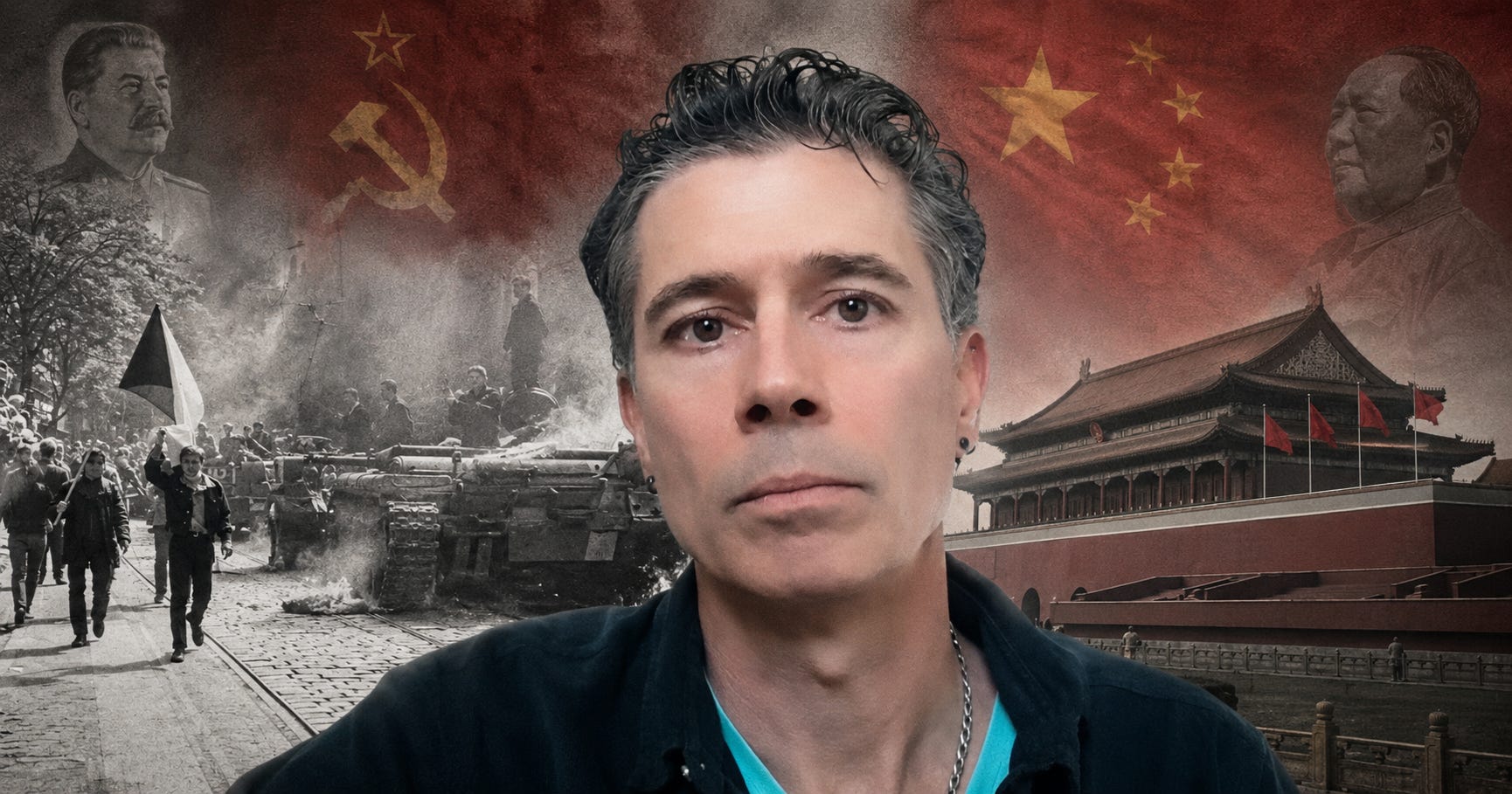
Many of my viewers and listeners have asked me what my thoughts are on Gabriel Rockhill. I have no personal issue with Rockhill as an individual; I don’t know the man. My issue is mainly with the kind of ideology he is selling. I have decided to write a critique of Gabriel Rockhill, because his type of arguments can sound, on the surface, like a version of the critique I have been making of the New Left, the cultural turn, and the left-wing academy. But make no mistake: it is not. In fact, the type of ideology Rockhill propagates is a prime example of some of the tendencies I have criticized in the “radical” wing of the PMC left in my past essays like “The Anti-Social Socialists.” But first, for those who don’t know, Gabriel Rockhill is a communist academic, a professor at Villanova University and the founding director of the Critical Theory Workshop, whose political project is not merely to criticize academia but to rehabilitate Marxism-Leninism and the legacy of what its defenders call actually existing socialism. His recent book, Who Paid the Pipers of Western Marxism? The Intellectual World War: Marxism Versus the Imperial Theory Industry (Monthly Review Press, 2025), presents itself as an exposé of how Western Marxism was shaped, funded, and promoted by the imperial theory industry.
The Notion of “The Compatible Left”
That book is the most systematic statement of a worldview Rockhill had already been developing in lectures and interviews on the “global theory industry” and “left anti-communism,” as well as in his attack on Slavoj Žižek, whom he treats as a celebrity figure of the compatible left: radical in style, anti-communist in substance, and useful to the ideological management of the Western academy (“Capitalism’s Court Jester: Slavoj Žižek”, CounterPunch, 2023).
His basic thesis is that the capitalist state, philanthropic foundations, universities, journals, and covert agencies like the CIA helped cultivate a domesticated anti-communist left that could criticize capitalism while steering radicals away from Leninism and actually existing socialist states. In this story, the Frankfurt School and later currents of French theory are not merely mistaken intellectual tendencies. They become part of an imperial system of knowledge production, an academic left allowed to exist precisely because it helps neutralize the revolutionary left.
The context prevents a lazy misreading of my own critique. Rockhill and I both criticize the New Left, the cultural turn, and the decline of class politics, but we do so from fundamentally opposed premises. He comes at the problem from a Marxist-Leninist standpoint. His complaint is that the Western academic left became anti-Soviet and anti-Marxist-Leninist, and that the decline of Marxism-Leninism was the great defeat from which the left must recover. My view is almost the reverse. Marxism-Leninism was not the buried cure that would have saved socialist politics. It was a major part of the disease: one of the traditions whose authoritarian record, strategic rigidity, geopolitical loyalties, and inability to speak to Western workers helped discredit socialism and push people away from it. What Rockhill treats as the solution, I see as one of the causes of the problem. He wants to recover the Leninist tradition. I want to understand why the Old Left declined and why the politics that replaced it became so detached from ordinary workers. Those are not small differences. They are the whole argument.
None of this means I am dismissing the problem of the cultural left. I agree with Rockhill that the decline of class politics and the rise of the cultural left were disastrous. In fact, I despise the cultural left: its moralism, its contempt for ordinary workers, its obsession with language and etiquette, and its substitution of symbolic purification for material politics. The difference is that Rockhill gets the sequencing backwards. He treats the cultural left as the result of anti-communist academics, liberal foundations, and CIA-compatible theory displacing the real communist left. My argument is that the cultural left emerged from deeper structural transformations: the collapse of working-class institutions, the rise of the Professional Managerial Class, the decline of socialist legitimacy, and the expansion of higher education that swelled the symbolic capitalist professions whose social power depends on managing discourse, credentials, status, and cultural meaning. For a fuller account of why the cultural left emerged, I would point readers to my Genealogy of Wokeism essays, especially Part 1, which draws on Musa al-Gharbi’s We Have Never Been Woke (Princeton University Press, 2024) to explain the class composition and professional dynamics behind this politics. Rockhill criticizes the New Left because it was insufficiently loyal to Leninism and actually existing socialism. I criticize the cultural left because it is a PMC politics that replaces class organization with consciousness, etiquette, identity, and status competition.
This is why the overlap can be misleading. Some people who like Rockhill may also enjoy my work because we hate many of the same tendencies. But hating the same people is not the same as having the same critique. The problem is not that the good communism was stolen from us by bad academics. The problem is that the historical failures of communism, including Marxism-Leninism itself, helped produce the vacuum in which cultural politics flourished.
So the central point of this essay is not that Rockhill literally blames the Frankfurt School for everything wrong with the left. That would be too crude, and it would also make the critique too easy. The more serious problem is that his project is a diversion. It takes the real historical problem of Cold War cultural patronage and turns it into a misleading explanation for the left’s decline, one that distracts from the failure of communism, the collapse of working-class institutions, and the inability of Marxism-Leninism to become an indigenous mass politics in the United States. In attacking the so-called compatible left, Rockhill ends up legitimating something worse: a self-contained opposition so incompatible with the society it inhabits that it flatters itself with its own marginality.
Funding, Compatibility, and the Frankfurt School Distraction
I want to avoid straw-manning Rockhill here. His argument is not always the crude claim that Adorno, Marcuse, or the Frankfurt School were simply taking orders from the CIA like puppets. The stronger version is subtler: if anti-communist institutions, liberal foundations, universities, journals, and covert Cold War networks supported or promoted certain forms of Western Marxism, then those forms of Marxism must have been structurally compatible with imperial power. In this framing, patronage becomes proof of political harmlessness.
There is a rational kernel in that argument. Funding is not meaningless. Institutions do not usually support ideas they regard as existential threats. If a ruling-class foundation, university network, or intelligence-adjacent cultural apparatus finds a tendency useful, that tells us something about the strategic situation in which that tendency is being circulated. The moment “who funded whom” becomes a substitute for asking whether an argument is true, whether a movement has a mass base, whether its politics can win, or whether its alternative is actually desirable, we have left material analysis behind and entered the world of insinuation.
One of Rockhill’s more dubious moves is his treatment of the Frankfurt School, especially Adorno, Horkheimer, and Marcuse, as if their Cold War circulation through liberal and anti-communist institutions can explain the collapse of the revolutionary left. There are real facts here: some of these figures published in venues later connected to CIA-backed cultural networks, and some of their work was certainly useful to anti-Soviet liberals. But the problem begins when this becomes a whole theory of left-wing defeat. Chris Cutrone has already worked through Rockhill’s handling of the Frankfurt School in detail in “The Frankfurt School Wanted Socialism: Contra Rockhill” (Platypus Review 187, 2026), documenting the selective quotations, the guilt-by-association method, and the habit of reducing these thinkers to the charge that they were not Soviet enough. I am not primarily interested in repeating that exercise here.
I am not interested in turning this essay into a defense brief for Adorno, Horkheimer, Marcuse, or French theory, much less in litigating whether they were sufficiently Marxist before Rockhill’s tribunal. The deeper issue is not that Rockhill misreads this or that theorist. It is that his entire framework misidentifies the problem. He treats the decline of the old communist horizon as if it were primarily the result of the wrong ideas being promoted by the wrong institutions. But the real problem was not that Western Marxism was captured by the wrong intellectuals. The problem was that Marxism in the West had become so overwhelmingly the property of intellectuals in the first place. (He builds the framework across “The CIA & the Frankfurt School’s Anti-Communism”, “The CIA Reads French Theory”, and “Foucault, Anti-Communism & the Global Theory Industry”, all in The Philosophical Salon.)
At this level, the critique becomes less a debate about the Frankfurt School than a broader alibi for the left’s downfall. Rockhill positions the pro-Soviet tradition as the suppressed cure, when it was itself part of the disease. Actually existing socialism did not merely fail to prevent the left’s demise. It helped produce it. Rockhill wants to celebrate failure as if it were success, and then blame the people who stopped believing.
Mistaking Cause and Effect
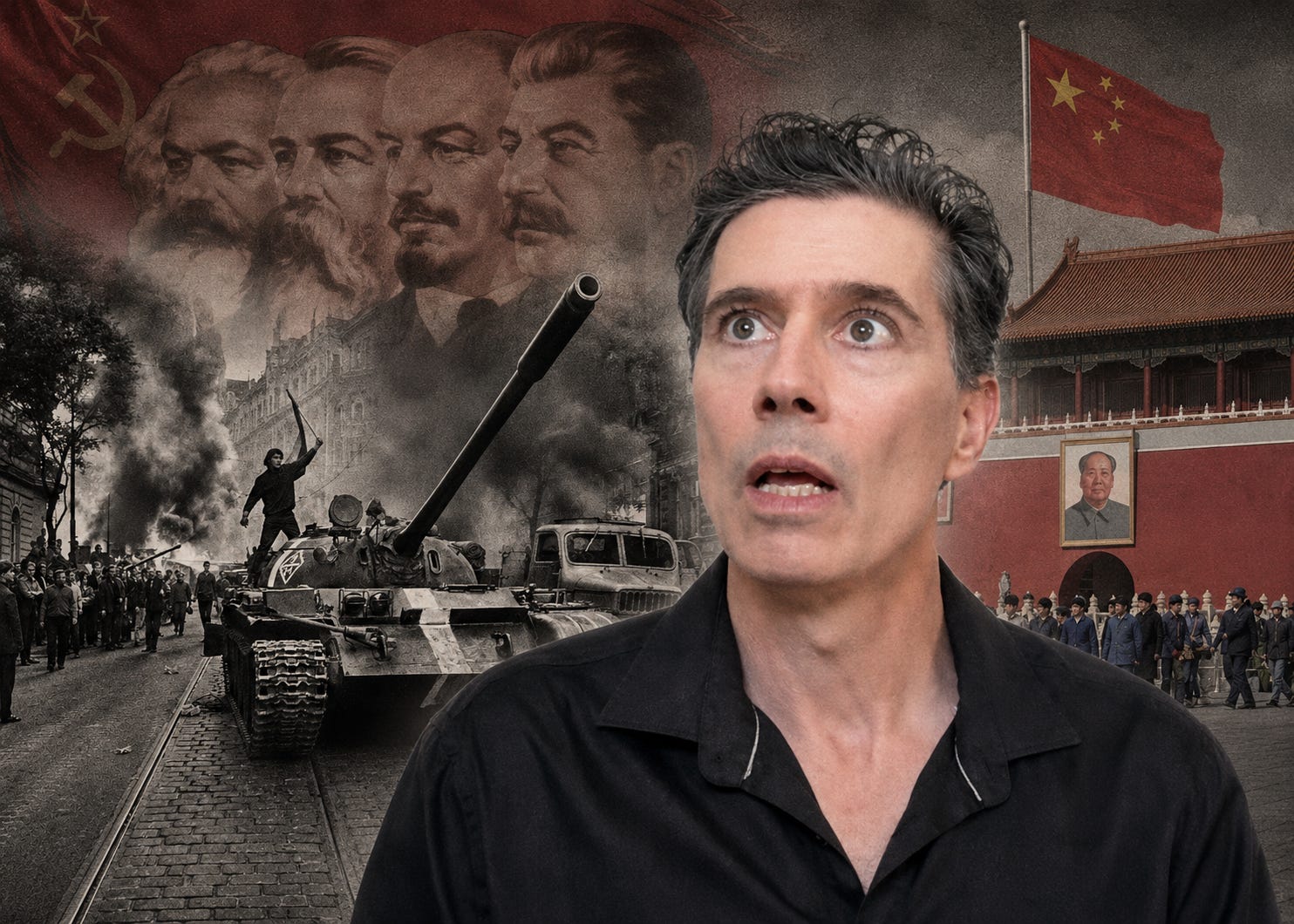
Rockhill treats the Frankfurt School and the French postmodernists as the cause of the compatible left rather than as a product of the material conditions that led to the decline of the Old Left and the rise of the New Left. He supposes that cultural politics, which came through the universities and deviated away from class, was the reason for the decline of class politics. In his telling, this was pumped up as a distraction, propped up by universities and backed by the CIA to create a fake left against the real one.
He gets the sequencing completely backward. What actually happened is that the cultural turn was a result of the decline of class politics, not the cause of it. The failure of communism and the widespread disenchantment with it created the conditions for the cultural turn. The decline of class politics created a vacuum, and cultural politics, what we now call “woke” politics, filled that vacuum. The sequencing is the difference between understanding history materially and understanding it conspiratorially.
Why would cultural politics suddenly become attractive to leftists if class politics were thriving? The New Left’s turn toward identity, culture, and lifestyle politics in the 1960s and 70s did not happen because some CIA handler whispered in their ears. It happened because the traditional working-class movements had already failed to deliver revolutionary change. The Soviet model had revealed itself as authoritarian and stagnant. Western communist parties had become sclerotic and disconnected from younger generations. Labor unions had been integrated into the capitalist system through the postwar compromise. Cultural politics did not kill class politics. It emerged from its corpse.
The core problem is not that the Western left is too compatible with liberalism but that it has failed to adapt to its own national conditions. Consider the United States: socialism never took root there, not simply because of McCarthyist repression, but because it never resonated with American political culture. The U.S. is the most quintessentially bourgeois country, with a deep Protestant, individualist tradition that is fundamentally skeptical of centralized authority. Socialist movements that succeeded elsewhere, in Russia, China, or Vietnam, did so not because they adhered to a pure form of Marxism-Leninism, but because they adapted Marxism to their own conditions. The Chinese Communist Party, for example, successfully incorporated nationalism and a focus on the peasantry, elements absent from classical Marxism. The American left, by contrast, has largely failed to create an indigenous form of socialism that speaks to the material realities and ideological tendencies of the American working class. Instead, it has often imported European models wholesale or, worse, retreated into insular academic discourse.
Rockhill ignores all of this because it complicates his narrative. His view is ultimately idealist, not materialist. It treats ideas as the primary motor of history rather than the political economy that shapes them. The New Left did not emerge because the Frankfurt School poisoned people’s minds. It emerged because the Old Left collapsed under its own contradictions and because the social terrain that once made class politics plausible had been transformed. In the United States, socialist movements never gained mass traction for a variety of reasons: racial and ethnic divisions, religious populism, Cold War repression, and the co-optation of labor unions into the postwar compromise. Mike Davis’s Prisoners of the American Dream (Verso, 1986) provides a far more serious historical account of why the American left repeatedly failed to take root than Rockhill’s story about philosophers and cultural manipulation. Structural causation is less flattering to his narrative than the idea that the real left was defeated by a fake one.
The point here is not that class politics was imaginary. Class politics emerged in the nineteenth century because industrial capitalism uprooted people from agrarian communities, concentrated them in factories and cities, and created a class of people whose freedom under bourgeois law sat alongside exploitation in production. Its premise was simple: solidarity is grounded in shared material interests, not in shared cultural taste, ideological confession, or possession of the correct consciousness. Workers did not become politically powerful because an intellectual priesthood awakened them. They became powerful when their structural position in production gave them leverage over capital. I have dealt with the longer genealogy of Marxism’s later consciousness-first mutation elsewhere, especially in Part 2 of my Genealogy of Wokeism series.
The cultural turn was not the magical product of bad theorists. It was the substitute politics that became available when the institutional bases of class politics were decaying. Once union density fell, socialist parties lost plausibility, and workplace organization became harder to sustain, politics migrated to the terrain where the new left-wing intelligentsia actually had power: universities, media, NGOs, publishing, and HR departments. Identity, discourse, representation, and consciousness-raising became the native politics of people whose careers revolved around symbolic manipulation. That is a structural class explanation, not a CIA morality play.
The Collapse Rockhill Avoids
The ideological blow was already visible in the Red Scares of the late 1940s and early 1950s. They did not only target communists. They damaged the broader infrastructure through which the Old Left exercised influence in unions, universities, and media. But it is a mistake to confuse McCarthyism with the original cause of communism’s unpopularity. Communism was already weak in America because its collectivist, statist, atheist, and totalitarian image clashed with a political culture shaped by Christian individualism and democratic liberalism. The Red Scare did not create anti-communism out of nothing. It capitalized on anti-communism, and then used the stigma of communism to discipline any politics of class struggle, socialism, or serious economic redistribution. That is why McCarthyism could deliver such a heavy blow. Communism was not popular enough for repression to become politically costly.
The comparative picture makes this obvious. In France, the Communist Party emerged from the war with major prestige from the Resistance and became an electoral force, winning roughly a quarter of the vote in 1945. In that kind of context, a U.S.-style Red Scare is far harder to pull off, because you are threatening a constituency embedded in workplaces, unions, and the broader political system. Anti-communism can still exist, but it cannot function as a sweeping purge without serious backlash. Britain and North America, by contrast, had communist parties that were far more marginal, and that marginality made repression easier and cheaper. The state could stigmatize communism, purge radicals, and discipline class politics without provoking the kind of mass backlash that would have followed in France. The strategic lesson is boring but decisive: if a movement is rooted in labor institutions and mass organization, it is harder to erase. If it is a sect, it is easier to stigmatize.
This is a more plausible story of Western communism’s weakness than the claim that a handful of compatible-left philosophers led people astray by promoting the wrong kind of communism. Rockhill wants McCarthyism to be the exonerating explanation for communism’s failure. In reality, McCarthyism was both a cause and a symptom: it weakened the Old Left, but it was also enabled by the fact that communism never had enough mass legitimacy to make the attack politically impossible.
Here the two critiques part company entirely. Rockhill’s problem with Western Marxism is that it was dominated by the wrong intellectuals. My problem is that, in the West, Marxism became so dominated by intellectuals at all. His complaint is that the wrong people in the ivory tower won the battle over theory. My complaint is that the whole battle was taking place in the ivory tower in the first place. This is why his critique never quite escapes the world it attacks. Rockhill is still fighting an intra-intellectual war over which theorists, journals, and academic lineages should have guided the left. But the deeper failure is that Marxism became, for much of the Western left, a self-referential language of intellectual distinction rather than a living politics of the working class. It was consumed, debated, denounced, footnoted, and ritualistically purified by intellectuals. Meanwhile, outside of exceptional cases like France and Italy, where communist parties had deeper roots in the working class and in anti-fascist partisan traditions, communist politics failed to become a mass working-class force in the West.
That is the real scandal. Marxism began as a theory of working-class emancipation, but in many Western contexts it became opium for the intellectuals. It allowed alienated students, academics, and symbolic capitalists to imagine themselves as the bearers of historical truth while the actual working class remained indifferent, skeptical, or hostile. The hard truth is that these ideas often failed because they did not provide a better, more appealing, or more trustworthy alternative. Communist regimes produced atrocities and bureaucratic nightmares. Cultural-left politics produced moralism, alienation, and contempt for ordinary people. In both cases, the problem was not that the masses were brainwashed. It was that the alternatives offered to them were historically compromised, socially repulsive, or politically unbelievable.
Re-Writing History
Above all, the greatest blow was the experience of actually existing socialism itself. It did more than give anticommunists ammunition. It shattered the confidence of many people who had wanted socialism to be the name for human emancipation. This is the part Rockhill’s story has to minimize, because the damage was not produced by the CIA inventing lies about communism. It was produced by communism’s own record becoming harder to deny.
The first great rupture was Khrushchev’s secret speech in 1956. It did not reveal the full story of the Soviet Union’s horrors, but it publicly cracked the myth of Stalin as the infallible builder of socialism. Earlier communists and Bolshevik sympathizers had often written without the later public record of purges, camps, famine, and terror being available in the same way. It is one thing to defend Marxist-Leninist communism in the absence of full knowledge of what was happening in the Soviet Union, as many communist-sympathizing journalists, academics, and artists did before the early 1950s. It is another thing to keep defending the same regime once its own leadership has begun admitting what happened.
Then came the brief hope that the socialist states might reform themselves. Hungary in 1956 was the first great test, and Soviet tanks crushed it. The pro-Soviet hardliners who defended that intervention are where the term “tankie” acquired its enduring meaning. The argument was familiar: this was not a real popular revolt, it was sabotage, counterrevolution, imperial manipulation, a color revolution before the term existed. The form of the excuse has barely changed. The Prague Spring in 1968 made the question even harder to evade. Alexander Dubček’s Czechoslovak reform movement was not a fascist coup or a capitalist restoration fantasy. It was an attempt at socialism with a human face, an effort to reform the system from within. When Warsaw Pact tanks rolled in to crush it, the dream that Soviet-style socialism could peacefully reform itself suffered a wound from which it never really recovered. If even that had to be destroyed, then what exactly was left to defend?
The final symbolic collapse came with the fall of the Berlin Wall and then the dissolution of the Soviet Union. By then, many intellectuals had already jumped ship into Eurocommunism, democratic socialism, post-Marxism, cultural politics, or anarchism. But 1989 to 1991 made the collapse visible to the whole world. The problem was not that socialism had been defeated from outside. The problem was that the most famous socialist project in history had become a byword for stagnation, repression, and failure. These are the basic realities that explain why cultural politics came to dominate and why communism lost so much authority. Not because the CIA invented anti-communism out of thin air, and not because a compatible left hypnotized everyone into forgetting Lenin, but because the old communist horizon became morally compromised, strategically exhausted, and socially unbelievable to millions of people who might otherwise have been open to socialism.
The structural blow was economic and institutional. Stagflation, the profitability crisis of the 1970s, the oil shocks, deindustrialization, and the hypermobility of capital all weakened the bargaining power of labor. Workers could still withhold labor, but capital increasingly had the ability to relocate, outsource, automate, or threaten to do so. Once the factory could leave, workplace power was no longer what it had been. The collapse of union density was not the result of workers forgetting the right theory. It reflected a transformed balance of power between capital and labor. At the same time, the managerial revolution and the massive expansion of higher education produced a much larger Professional Managerial Class, especially the symbolic capitalist fraction of it: academics, journalists, nonprofit workers, administrators, and HR professionals whose social power comes from managing discourse, credentials, prestige, and representation. When these strata inherited or colonized left-wing institutions, their politics naturally centered the terrain on which they had competence and status. They did not need the CIA to tell them to care about language, identity, and representation. Their social position already pushed them in that direction.
That is the real story of the New Left and the cultural turn. The old working-class institutions weakened. Communism lost intellectual legitimacy. Capital became more mobile. The PMC grew. The left’s center of gravity shifted toward the institutions where symbolic capitalists lived.
There is another reason Rockhill’s account is so attractive to a certain kind of leftist. It converts failure into sabotage, or at least into externally managed diversion. It takes the long, humiliating history of left-wing defeat and gives it a villain with a budget, a paper trail, and an institutional network. This is not to say that the CIA, foundations, or the Congress for Cultural Freedom did not matter. But none of them explain why the left proved so vulnerable to capture, professionalization, and symbolic substitution in the first place. A serious materialist analysis would ask why the old working-class left lost its social base, why communism became morally and politically discredited, why the Professional Managerial Class became the dominant carrier of left-wing politics, and why universities replaced unions as the left’s central institutions. That is the terrain I am analyzing in my own work, especially in my Genealogy of Wokeism essays and my critique of anti-social socialism.
Rockhill wants to locate the decisive betrayal in the compatible-left apparatus and the anti-Soviet Western Marxists it elevated. But the harder truth is that much of the left became internally predisposed to forms of politics that were easier to contain, commodify, professionalize, and moralize. Opposition need not be controlled if it becomes contained via self-marginalization, and the Marxist-Leninist tradition Rockhill wants to rescue was itself one of the things that helped make socialism politically radioactive. It is hard to imagine Gabriel Rockhill’s narratives resonating with anyone outside of niche Marxist circles. His story about the Frankfurt School and the “global theory industry” makes sense mainly to communist ideologues who hyper-specialized in continental theory (and lack deep knowledge of history & practical political economy), then grew disenchanted with the political uselessness of the theory they spent all that time learning. I wouldn’t dismiss anyone by psychologizing them, but this seems to be the case with Rockhill himself, who did his entire PhD on French theory prior to developing an obsession (even greater than Jordan Peterson’s) with turning left-Academia’s favorite critical theorists into supervillains. Nevertheless, it makes sense why Gabriel Rockhill’s narrative can also be dangerously seductive to newly radicalized communist radicals looking for simple answers to cope with the pathetic impotence of the Western left. It offers them a clean map of betrayal. It tells them the tradition did not fail because it became authoritarian, strategically sterile, socially alienating, and incapable of building trust among ordinary people. It failed because the wrong theorists were promoted and the right tradition was suppressed. That is not a serious explanation. It is miseducation with footnotes. It’s a self-referential legitimation story for communist aspirants of the Rebel Priest Class who implicitly think that the Brahmin Left could have been a real vanguard of the proletariat if only it were their kind of communist picked for the caste. Aside from adults who are still Marxist-Leninist in 2026 and want to cope by convincing themselves their camp was on the right side of history, younger radicals, or newly radicalized radicals, can be an easy audience for Rockhill’s kind of narratives. Because they often lack experience and deep knowledge of the issues they speak about, yet are broadly educated just enough to convince themselves they have already arrived at the correct answers to manage the rest of society. When confronted with the questions about why communism failed, and why so few people want to try it again, it’s not hard to see why even “Marxists” might be susceptible to a story that scapegoats a bunch of jaded European-Jewish intellectuals so they don’t have to confront the painful realities about the left’s deep structural problems.
Much of the “Old Left” Was “Anti-Communist” As Well
Rockhill’s narrative also obscures an important distinction between the Old Left and the New Left. The Old Left in the United States was not simply a communist bloc defeated by liberal anti-communists. It was itself divided between communists and anti-communists, and much of the American left, especially its social-democratic, labor, and union currents, was anti-communist. The communist left was always more marginal in the United States than Rockhill’s mythology allows, and it became more marginal still as the atrocities and failures of the Soviet regime became harder to deny.
The paradox is that the New Left was, in many ways, more anti-anti-communist than the Old Left. Todd Gitlin’s The Sixties (Bantam Books, 1987) captures this shift well: Students for a Democratic Society did not begin as a Soviet-line communist organization, but it increasingly rejected the old liberal-socialist discipline of anti-communism. Later, more radical currents in the 1960s and 1970s, including the Weather Underground, sections of Black Power, and the Black Panther Party, moved toward more communist, anti-imperialist, or Third Worldist sympathies. But this still does not vindicate Rockhill’s argument. These movements could become security problems for the American state without becoming serious political alternatives capable of governing the country or reorganizing American society.
The Threat Fallacy
Rockhill’s compatible-left narrative only works if “threat” is treated as a single category: the more hostile a movement is to the American state, the more revolutionary it must be. But a movement can be a geopolitical liability, a security risk, or a public-order problem without being a serious political alternative capable of reorganizing society.
Soviet-aligned communist parties were certainly treated as threats by the American state. But what kind of threat? In the context of the Cold War, they were dangerous because they were associated with a rival geopolitical bloc, because they could be suspected of espionage or internal sabotage, and because their loyalties appeared to align with a foreign power hostile to American interests. But it is not the same as having a realistic capacity to win mass support, displace the regime, and reorganize American society. Rockhill’s thesis depends on sliding between these two meanings. The compatible left is supposedly compatible because it does not threaten the ruling order, while the Soviet-aligned Marxist-Leninist left is treated as the truly incompatible alternative. But incompatible in what sense? In geopolitical terms, yes. A Communist Party taking instructions from Moscow was incompatible with American national security interests. In political terms, the American Marxist-Leninist left was nowhere near power, and it had no realistic path to government.
This is where his argument becomes strangely circular. The Soviet-line left was persecuted, therefore it must have been dangerous. It was dangerous, therefore its defeat must prove that the American state feared its revolutionary potential. But states persecute many things for many reasons. They persecute threats to public order, threats to national security, threats to elite cohesion, and sometimes threats that are more symbolic than practical. The fact that a movement is repressed does not automatically mean it was close to victory, or ever had the potential for it. Communism was easy to persecute in the United States not because it was on the verge of taking power, but because it was already culturally and politically weak.
A useful analogy is the contemporary figure of the American who openly supports China against the United States. Such a person may be seen as a geopolitical liability. He may be accused of undermining national interests, spreading hostile propaganda, or aligning with a rival power. But that does not mean he is about to lead a popular revolution. His incompatibility with the American state does not translate into mass political capacity. In fact, his open alignment with a rival geopolitical power may make him even less capable of building a popular movement inside America. This is the biggest fallacy at the heart of Rockhill’s analysis. He treats the very thing that made Soviet-aligned communism alien to American political life as evidence of its revolutionary seriousness. But incompatibility is not capacity. Marginality is not radicalism. A movement can antagonize the state and still be mistrusted by the society around it. Ordinary people may not see it as a liberating force at all. They may see it as a nuisance, a danger, or a disorderly force the state should put to bed.
Being Radical Does Not Automatically Make It Better
There is one more confusion hidden inside Rockhill’s use of “threat.” Even if a movement does pose a real threat of political change, that does not mean the change in question is desirable. Fascism is treated as one of the great threats to the current order, and in many elite cultural spaces it is far more stigmatized than communism. But none of this makes fascism good politics. It only shows how useless “threat” is as a moral category. A politics can be dangerous, viable, and still monstrous. The same standard has to be applied to Leninism. Even if Marxism-Leninism was once a real threat in parts of the world, and even if it was viable in certain national contexts, that does not make it desirable. That something frightens the regime is no reason to want it. Machiavelli’s famous advice that it is safer to be feared than loved was written for princes, not for mass movements that claim to liberate a people.
Italy is a useful example here precisely because communism was once a serious mass force there. But there is little reason to assume Italy would have been governed better under a Soviet-style system than under the corrupt but successful postwar Christian Democratic order, with its labor compromises, social-democratic concessions, and extraordinary economic recovery. Compared with East Germany and much of Soviet-dominated Eastern Europe, postwar Italy recovered far better. So even where communism was viable, viability did not prove desirability.
The Romance of Anti-Imperialism
But what about the Third World? The obvious counterpoint that Rockhill and people of his kind like to make is that Marxism-Leninism did pose a real threat there. That is true, but only if we keep the category clear. It posed a geopolitical threat, not a proof of universal political capacity. A doctrine can become powerful as the language of anti-colonial war, Soviet arms, national liberation, and state formation without becoming a viable domestic strategy in the United States. That distinction is exactly what Rockhill’s framework blurs.
The same confusion appears across radical left mythology more generally. Many leftists treat any movement targeted by the state as if it must have been on the verge of transforming society. The Black Panthers are the classic example. Because the Panthers were brutally targeted by COINTELPRO, and because Fred Hampton was murdered by the FBI, many radicals retroactively imagine them as a revolutionary force that was about to overthrow the American system if only the state had not intervened. The repression was real. The murder of Fred Hampton was monstrous. The FBI’s war against black radicals was one of the most shameful episodes in modern American political history. But none of that requires us to inflate the Panthers into a movement with a plausible path to communist revolution in the United States. They were a serious organization, a symbolically powerful one, and in some cities a socially rooted one. They were not a mass party on the verge of taking state power.
The same point applies to the Weather Underground, the Symbionese Liberation Army, and other militant splinters of the late New Left. They were treated as threats, and in some cases they really were security risks. But a security risk is not the same thing as a political alternative. The FBI was not afraid that the Weather Underground was going to win an election, form a government, and create socialism. It was afraid of bombings, guerrilla fantasies, armed confrontation, foreign ideological alignment, and the politicization of black and white radicalism in ways that made the transition out of legal segregation less governable. The American state was not only suppressing revolutionary potential. It was also trying to impose order in a period of urban unrest, racial conflict, riots, and institutional panic after the civil rights era. I am not defending COINTELPRO. It was coercive, often illegal, and morally indefensible in many of its operations. But it is also true that COINTELPRO did not only target Black Power groups. It also targeted white hate groups, including the Ku Klux Klan. Before federal infiltration and prosecution weakened it, the Klan was a far more serious force in American life than people today often remember. You can, in a very narrow historical sense, thank federal repression for helping to neutralize it, which is a sentence I would almost never write without qualification. But that is exactly the point: the state’s hostility is not a certificate of emancipatory potential.
Many far-left activist scholars continue to assume that anything capable of threatening order is therefore capable of producing liberation. But destabilization and transformation are not the same thing. A riot can destabilize order. A sect can destabilize order. A crime wave or a collapsing state can destabilize order. ISIS was a threat. Ted Kaczynski was a threat. None of this means any of them had the slightest capacity to deliver emancipatory structural change. In fact, destabilization often produces the opposite of what radicals imagine. It can produce backlash, reaction, militarization, emergency politics, or a frightened public begging for order. The fantasy is that disorder automatically opens space for revolution. History is crueler than that. Disorder opens space for whoever is organized enough, legitimate enough, and ruthless enough to fill the vacuum. Sometimes that is the left, but usually it is not.
This is also where Rockhill ends up sharing a fantasy with the anarchists he would presumably despise. The anarchist often imagines that being more disruptive, more hated by police, or more visibly repressed means being more dangerous to the establishment than the so-called bourgeois reformer. Rockhill makes a similar mistake with Soviet-aligned communism. But the police are as often policing disorder as they are policing a threat to ruling-class power. Sometimes you are simply an easy target, or a convenient symbol of disorder. To confuse those things is to mistake social disruption for social revolution. The real question is whether a movement can build legitimacy, institutions, coalitions, discipline, and a plausible alternative capable of winning broad consent. Rockhill collapses the distinction because his entire theory requires it. The argument only works if one forgets that a movement can be deeply incompatible with the state and still politically useless.
Compatible, or Not Compatible Enough?
This is where Rockhill’s thesis has to be flipped on its head. A movement being compatible with the social and political culture of the country it operates in does not automatically make it less threatening to the ruling order.The least compatible movements are often the easiest to isolate, ridicule, police, and quarantine. The movements that actually transform societies usually speak through the inherited moral language of the society they inhabit, turn that society’s own sources of legitimacy against its rulers, and present radical change as the fulfillment of ideals the existing order has betrayed.
Such movements do not simply say: everything you believe is false, every hero you admire is evil, every tradition you inherited is a prison, and now we will re-educate you into the correct consciousness. They say something much more politically powerful: your rulers have betrayed the very principles they claim to represent, and we are the ones who will make those principles real.
The American Revolution was not legitimated as a foreign rupture from British political culture. It was legitimated by turning British constitutional liberalism against Britain. The colonists argued that Britain was betraying its own inherited principles: limited government, representation, the rights of Englishmen, and the consent of the governed. They pushed those ideas further than Britain itself was willing to go, but they did so by presenting themselves as the true defenders of them. The revolution succeeded, in part, because it made radical rupture appear as fidelity to a betrayed tradition. The same pattern appears in national liberation movements. Mao did not win by presenting himself as a disembodied Marxist formula floating above China. He tied communism to Chinese national salvation, anti-imperial struggle, peasant grievances, and the legacy of Sun Yat-sen. Ho Chi Minh invoked the language of national independence and even echoed the American Declaration of Independence. Castro did not first appear to Cuba as a Soviet bureaucrat with a five-year plan. He invoked José Martí, Cuban independence, and anti-imperial patriotism. They did not succeed by being culturally unintelligible. They succeeded by indigenizing radical change.
This is also why the civil rights movement was so powerful. It did not stand outside America and denounce every American ideal as a lie. It exposed the contradiction between America’s professed ideals and its actual practices, using Christianity, constitutionalism, patriotism, and democratic language against segregation. Its power came from forcing the regime to confront itself.
All of this is the opposite of the approach taken by Leninists obsessed with cultural hegemony. They imagine politics as a long project of counter-hegemonic institution building, cadre formation, and mass re-education, as if ordinary people must first be processed into the correct ideological vocabulary before politics can begin. But successful transformations rarely begin by telling people that their whole moral world must be replaced by a foreign theoretical language. They begin by finding the contradictions inside that world and exploiting them. This is exactly the problem Christopher Lasch diagnosed in The Agony of the American Left (Knopf, 1969), a far better account of the American left’s failures than Rockhill’s compatible-left mystifications. Lasch saw that the American left repeatedly failed to develop an indigenous socialism of its own, first by importing European Marxism and Leninism, and later by trying to model itself on Third World guerrilla struggles and decolonial fantasies drawn from contexts radically removed from its own. The result was not a left more capable of transforming American society, but one increasingly trained to fetishize foreign revolutions while becoming more resentful toward its own country, its own people, and its own inherited political languages.
What Rockhill never considers is that compatibility with a nation’s inherited political traditions can be used to make radical politics intelligible to normal people. To speak through a society’s moral vocabulary is not necessarily to surrender to that society. Sometimes it is the only way to turn that society against its rulers. Rockhill treats a movement’s incompatibility with the status quo as if it were proof of revolutionary gravitas, but this is exactly backwards. A movement can be so incompatible with the political culture of a country that it becomes politically harmless. It can be too foreign, too sectarian, too hostile to the inherited moral imagination of ordinary people to ever become a mass force. Soviet-style Marxism-Leninism in the United States is a perfect example. Its very alienness was not proof of its power. It was one of the reasons it could not win.
The real question, then, is not whether a movement is compatible or incompatible in the abstract. It is compatible with what, and for what purpose. Compatible with ruling-class institutions, donor networks, career incentives, and academic prestige? That is one thing. Compatible with the moral language, historical memory, religious inheritance, and democratic ideals through which ordinary people understand political legitimacy? That is something else entirely. The most dangerous opposition is not always the most alien opposition. Often, it is the opposition that can say to the regime: you are the betrayal, and we are the fulfillment.
Controlled Opposition vs Self-Contained Opposition
Rockhill’s portrayal of the compatible left as a form of controlled opposition has to be distinguished from what I have called self-contained opposition, which is a theory about the self-marginalization of radical movements. Controlled opposition implies an external manager, a puppet master, a hidden hand deciding which dissidents are allowed to exist. Self-contained opposition is more subtle, and more damning: opposition can contain itself. It does this when it adopts forms, slogans, aesthetics, and theories that make it unintelligible or repulsive to the people it claims to represent; when it chooses subcultural purity over mass persuasion; when it mistakes alienation for radicalism and moral performance for strategy; when it becomes a market niche, a credentialing mechanism, a publishing brand, a podcast identity, or a way for symbolic capitalists to distinguish themselves from other symbolic capitalists.
This is why the easy distinction between safe opposition and dangerous opposition is often misleading. A movement can be disruptive, frightening, and socially inflammatory while also being politically sterile. Conversely, a movement can appear moderate, procedural, or compatible while slowly transforming institutions, reshaping common sense, and extracting real concessions. Many radicals refuse to understand this. They measure seriousness by how much the regime hates them. Sometimes the system persecutes you because you matter. Sometimes it persecutes you because you are weak enough to crush.
The deeper problem with Rockhill’s theory is that it lets the left avoid this distinction. It tells a comforting story in which the authentic left was defeated by manipulation, while the compatible left was promoted by imperial power. But the reality is harsher. Much of what calls itself radical opposition is already self-marginalizing. It does not need to be controlled because it has no path to power. It can scream against the system forever while functioning as a contained subculture inside the very society it despises. I first introduced the concept of contained opposition over four years ago during my master’s degree, and I have developed it more fully in my forthcoming book Freedom to Change Nothing. The modern regime does not only contain opposition by censoring, bribing, or infiltrating it. It also contains opposition by allowing it to select for its own marginality. Markets, institutions, platforms, academia, and subcultural incentives reward forms of dissent that are expressive rather than strategic. Such opposition can feel dangerous, since it is rhetorically extreme, while remaining harmless, since it cannot build power.
At the heart of Rockhill’s project is an attempt to rehabilitate Marxism-Leninism, especially in its pro-Soviet and pro-Chinese forms. That is why the compatible-left thesis matters so much to him. He is not simply saying that liberal anti-communism shaped Western theory. He is trying to show that other leftisms were compatible with imperial power while his preferred tradition was not. The conclusion is implied even when it is not stated directly: if the compatible left was fake, then the incompatible left must have been real.
Third-Worldist Vicarious Fetishism
Once Rockhill’s compatible-left narrative is stripped of its Cold War machinery, his politics often amount to third-world vicarious fetishism. He condemns the Western left for being too compatible but never shows how the Marxist-Leninist communism he implicitly offers as the alternative could ever work as a mass politics in a Western country like the United States, or even why it failed in the places where it once had a chance, like France and Italy. His readers come away with almost no serious account of what went wrong with actually existing socialism. Deep down, Rockhill and the tankies of his kind know that their neo-Stalinist politics are never going anywhere in the societies they actually inhabit, so they escape politics altogether through fantasy. In that fantasy, the real revolutionary subject of history is always somewhere else for them to support at a distance: China, Vietnam, Cuba, the anti-imperialist state, the foreign regime imagined as carrying history on behalf of a Western left with no mass base at home. This is not politics, let alone revolutionary politics. It is vicarious cheerleading, a way of coping with the impotence of the Western left by pretending the grass is greener on the other side. His celebration of actually existing socialist states lets their persistence stand in for proof of their superiority, while avoiding a serious confrontation with exploitation, class discipline, and state-capitalist realities inside them.
The movements that later appeared as Marxist-Leninist were powerful because they fused anti-colonial nationalism, peasant grievances, military organization, and the promise of national independence. Some adopted Marxism-Leninism sincerely. Others formalized or publicly performed Marxist-Leninist commitments because that was the language through which one entered the Soviet orbit and received weapons, training, and diplomatic support. To say this is not to deny their agency. It is to acknowledge that actually existing socialism, where it “succeeded,” came to power and stayed in power because of particular geopolitical circumstances and because its leaders adapted to those conditions, not because they simply followed what Rockhill treats as the immortal science of Marxism-Leninism.
What is missing from this worldview is any serious conception of social revolution as something that has to involve society itself: the people, their institutions, their moral languages, their fears, their loyalties, and their inherited forms of life. Rockhill can think in terms of power structures, ideological apparatuses, and counter-hegemonic institutions, but his deeper model of success remains Bolshevik: a disciplined minority seizes power from above, then society is remade through the state. That is why the actual problem of winning a people tends to disappear. He has no comparable account of what an indigenous socialism in the United States would look like. There is almost no America in his political imagination except empire, settler colonialism, anticommunism, and repression. His implicit solution is not to build a socialism that can speak to American workers, American history, American religious inheritance, or American democratic mythology. It is to hope that American power declines from without and that the collapse of the empire will somehow clear the road for socialism elsewhere. When this gets called decolonization, it often sounds less like a political project than a euphemism for balkanization, as if the dissolution of the country were itself a progressive program.
This is the dream world of a certain third-worldist anti-imperialism: if the American empire falls, socialism will finally breathe. But this is another alibi. Without the American empire, there would not be a frictionless world of emancipatory socialism. There would be other empires, other ruling classes, other capitalist blocs, and other geopolitical projects competing for domination. The socialist bloc itself had trading partners, subsidies, security arrangements, client states, and its own imperial margins. Its failures cannot be explained away by pointing endlessly to Washington. In Rockhill’s world, socialism does not really fail. It is defeated, betrayed, revised, infiltrated, or sabotaged. China is still socialist. Vietnam is still socialist. The Soviet Union fell because of revisionism, Gorbachev, or betrayal. The point of the story is always the same: the tradition is spared the humiliation of self-examination.
Readers who want a map of this ideological tendency can watch my long video “Every Type of Marxism Explained (Iceberg).” In many ways, Rockhill is simply a more intellectualized version of that tendency: a defender of so-called actually existing socialism with better prose, a PhD, and a gown. A Stalinist in academic robes is still a Stalinist.
Re-Education and Red Wokeness
Once this history is in view, Rockhill’s alternative is not a return to materialism at all. It is a Marxist-Leninist version of the same consciousness-first politics I have criticized in my Genealogy of Wokeism series. His solution is not to build a politics that meets working people where they are. It is to build counter-hegemonic institutions, capture educational spaces, and re-educate the masses into the correct communist consciousness. The form is the same pathology: belief first, coalition second, and power forever deferred until people have been awakened to the Marxist-Leninist line.
The real audience for this politics is not ordinary people, who could not care less about whether Žižek, Adorno, or the Frankfurt School are sufficiently Marxist-Leninist. Rockhill’s debate is mostly with intellectuals themselves, with the theorists, academics, and students who are not Marxist-Leninist enough for his liking. The fantasy is that if the Marxist-Leninist line could conquer the institutions, if academia were no longer subordinated to what he calls the imperial theory industry, then the left would somehow recover its revolutionary vocation. What Rockhill wants is not for Marxism to escape the ivory tower, but for Marxist-Leninists to take command of it. The problem, for him, is not that ordinary workers have seen enough of actually existing socialism to find communism unattractive. The problem is that they have not been given the right consciousness by the right vanguard.
The whole worldview then collapses into projection. The Rockhill-style communist looks at the actually existing working class and concludes that workers are not flocking to crusty sectarian communist parties because they have been brainwashed by bourgeois propaganda. But this is just the red version of woke consciousness-raising. Instead of asking what workers actually want, how they understand their interests, or why they might be skeptical of communist politics, the answer is always that the masses need more education, more counter-propaganda, more ideological correction, more vanguard leadership. The irony is that the people most invested in this fantasy are rarely workers themselves. They are usually overeducated students, underemployed graduates, academics, podcasters, and leftist autodidacts whose main currency is theoretical fluency. They master the right vocabulary, denounce the right deviations, and then imagine themselves as the advanced layer whose task is to enlighten everyone else. This is why many communist spaces end up looking less like organs of the working class and more like secular Jehovah’s Witnesses with reading groups, slogans, internal purges, and a shared fantasy of being vindicated by history.
Here Rockhill’s politics and liberal woke politics secretly share a form. Both presume that the central barrier to political transformation is incorrect consciousness. Both elevate the educated interpreter into the one who sees what ordinary people cannot. The liberal version says workers need anti-racist, feminist, and decolonial re-education. The red version says they need anti-imperialist, Marxist-Leninist re-education. But in both cases, the people are treated as raw material to be processed by the enlightened. Rockhill’s critique of the compatible left simply replaces liberal wokeness with red wokeness. The costume changes, but the class position remains. The result is not a more serious left. It is the same academic politics in a hammer-and-sickle costume.
Conclusion: Persecution Envy Is Not Politics
Rockhill’s critique ultimately mistakes rejection by the regime for revolutionary promise. That is the hidden romance beneath the compatible-left thesis. The communist was persecuted, therefore he must have been powerful. The liberal left was tolerated, therefore it must have been fake. The radical was incompatible, therefore he must have been the true alternative. Marx would be rolling in his grave seeing how so-called Marxists like Gabriel Rockhill dress up persecution envy as profound materialist analysis.
The lesson to take from Rockhill’s work is not that Adorno, Marcuse, Foucault, or the Western Marxists secretly ruined the left. The real lesson is that a left that cannot explain its own failure will always invent a betrayal story to protect itself from reality. His betrayal story is seductive because it tells alienated radicals that communism did not lose legitimacy because of its own record, its authoritarianism, or its inability to speak to ordinary workers.
A left that wants to actually make a difference cannot console itself with the fact that the state dislikes it. It has to ask why ordinary people do not trust it, why workers do not join it, why its institutions collapse into academia and subculture, and why its most radical factions so often become more invested in being persecuted than in becoming persuasive. A politics that cannot survive contact with the people it claims to liberate is not more radical. It is merely more isolated. Being hated by the state does not automatically mean being loved by the people.
Works Cited
al-Gharbi, Musa. We Have Never Been Woke: The Cultural Contradictions of a New Elite. Princeton: Princeton University Press, 2024.
Cutrone, Chris. “The Frankfurt School Wanted Socialism: Contra Rockhill.” Platypus Review 187, June 2026. https://platypus1917.org/2026/06/01/the-frankfurt-school-wanted-socialism/.
Davis, Mike. Prisoners of the American Dream: Politics and Economy in the History of the U.S. Working Class. London and New York: Verso, 1986.
Gitlin, Todd. The Sixties: Years of Hope, Days of Rage. New York: Bantam Books, 1987.
Lasch, Christopher. The Agony of the American Left. New York: Alfred A. Knopf, 1969.
Rockhill, Gabriel. “Capitalism’s Court Jester: Slavoj Žižek.” CounterPunch, January 2, 2023. https://www.counterpunch.org/2023/01/02/capitalisms-court-jester-slavoj-zizek/.
Rockhill, Gabriel. “The CIA & the Frankfurt School’s Anti-Communism.” The Philosophical Salon, June 27, 2022. https://thephilosophicalsalon.com/the-cia-the-frankfurt-schools-anti-communism/.
Rockhill, Gabriel. “The CIA Reads French Theory: On the Intellectual Labor of Dismantling the Cultural Left.” The Philosophical Salon, February 27, 2017. https://thephilosophicalsalon.com/the-cia-reads-french-theory-on-the-intellectual-labor-of-dismantling-the-cultural-left/.
Rockhill, Gabriel. “Foucault, Anti-Communism & the Global Theory Industry: A Reply to Critics.” The Philosophical Salon, February 1, 2021. https://thephilosophicalsalon.com/foucault-anti-communism-the-global-theory-industry-a-reply-to-critics/.
Rockhill, Gabriel. “The Global Theory Industry & Left Anti-Communism.” Lecture, Critical Theory Workshop Summer Program, July 7, 2021. YouTube..
Rockhill, Gabriel. Who Paid the Pipers of Western Marxism? The Intellectual World War: Marxism Versus the Imperial Theory Industry. Vol. 1. New York: Monthly Review Press, 2025.
Yates, Michael D., and Gabriel Rockhill. “An Insider Critique of the Imperial Theory Industry: Gabriel Rockhill Interviewed by Michael Yates.” MR Online, November 21, 2025. https://mronline.org/2025/11/21/an-insider-critique-of-the-imperial-theory-industry-gabriel-rockhill-interviewed-by-michael-yates/.
Your support helps keep my entire 1Dime project alive and independent! Support my work on Patreon to get access to over 100 exclusive episodes of the 1Dime Radio podcast and private Discord access.
You’ve got saintly patience and fair mindedness to write these articles, Tony. What I noticed years back was getting a social studies PhD in America—maybe in Canada, too—is a hazard to your health and everyone else’s. Sad as hell cause every nation needs public intellectuals. Yet so many thinkers (right, center, left) across multiple generations are stuck in adolescence down here. They smell their own farts for a living instead of serving the public. They do nothing and say too much. For a couple Starbucks gift cards, Professor Rockhill could’ve had coffee with anyone who grew up in Russia or under the Iron Curtain and learned how little of a paradise it was. Hell, just read Soviet science fiction like the Strugatsky bros or what folks said after the Molotov–Ribbentrop Pact. Doesn’t mean we can’t celebrate what victories Marxists won in all those revolutions, even their accomplishments in America or in your country too, but being a grown up means seeing good, bad, and ugly in any ideas you’re promoting.
I really like your article and the arguments you make. I'm a fairly long term listerner of yours and also follow theory underground and the dangerous maybe. Several years ago I used to be quite taken by Marxist Lenininist arguments. By chance Gabriel Rockhill caught my attention about a week ago and I've been watching interviews of his this week to try and catch up on his views. Now I stumble upon your article and it's perfect timing.
Getting to the end of your article I am left with the impression that for Marxism Leninism, The Way is Shut.
Benjamin Studebaker makes the argument that for the left in America and globally that The Way is Shut, primarily because of capital mobility and the need for international solidarity to limit capital mobility, and that this is international solidarity is unlikely to happen.
Your article here leaves hints that you think that there is some better alternative for emancipation than Gabriel Rockhill's Marxist Leninism, but I'm yet to find where you lay out clearly what think the alternative or alternatives might be.
It seems like at present the vast majority of destinations are either atrocity filled or fanciful, and the vast majority of the paths to emancipation are closed off.
It is easy to become a doomer, or retreat to the depth of the french philosophy that Rockhill critcises.
Or perhaps to give in to the inevitability of Nick Land's accelerating techno capital singularity becoming the end of humanity as we know it.
I look forward to seeing how you thread the needle between this impossible mess. Hopefully in future articles you can find a way through this maze filled with dead ends.
In particular I would like to know how you resolve your anti woke arc. If rasing consciousness before taking action is the wrong path, is raising consciousness during or after political action acceptable or useful.
Theory Underground seems to have a strategy of education and consciousness raising on a generational timescale, betting on the assumption that only or children or grandchildren have a chance for meaningful emanicipatory change and only after they achieve a significant level of education.
But you on the other hand seem to be hinting at shorter term political solutions being viable without education and consciousness raising.
I don't see how that is a viable path forward, but I'm open to hearing you explain and develop these ideas in your future content creation.
I would be thrilled if you respond to this comment, or if you read it at all. But for the sake of feedback I thought it may be useful for you to hear where I am hoping you further develop and explain your thoughts.
If you have already answered these questions in another article, I would be greatful to yourself or any other commenter who can point me to it.