

Is Communism Good (Even in Theory)?
The saying goes that communism “sounds good in theory but doesn’t work in practice.” But when you really think about it, does it sound good even in theory?
This essay is the Part 2 follow-up to my previous essay, “Why I Am Not a Communist.” In that essay, I explained why I am not a communist, even though I consider myself a socialist in a certain sense, and why I do not think communism is possible in practice at a civilizational scale. In this essay, I question whether communism even makes sense in theory. Is it truly the most morally just system? Is it the best end goal for human evolution?
Karl Marx famously proclaimed that the higher phase of communist society would be guided by the maxim: “From each according to their ability, to each according to their needs.”[1] There is something undeniably attractive about this vision. It suggests that under communism, our basic needs would be secured, liberating us to fulfill our true potential, currently constrained by the compulsions of wage labor and the relentless pursuit of profit for capitalist elites. Yet we must examine one word in this maxim: ability.
Most people think of communism as a society of economic equality, but for Marx, equality of outcomes was never really the principle. In the lower phase of communism, often called socialism, goods are still distributed according to one’s work. Only in the higher phase, the truly classless society, does distribution follow the maxim of ability and needs.[2] Nonetheless, the popular image is not entirely wrong. A classless society is, in some sense, a society of relative economic equality, and that is part of the Marxist premise. But relative economic equality would not end inequality. People would still differ in their abilities, and if the inequalities that remain are based on ability, they are based on natural hierarchies.
Anarchists have often argued that the concept of “ability” is inherently ableist, and while some of these objections can sound rather pedantic, they contain a kernel of truth. They point to a question that goes to the very foundation of communist theory: would a society in which hierarchies are determined by ability necessarily be more just or fair than the society we have now?
This might seem an odd question. Isn’t meritocracy based on ability the most just foundation for hierarchy, far superior to privilege or inherited status? But what if we examined ability itself as a form of privilege? Ability doesn’t emerge from thin air; it correlates strongly with genetics, upbringing, and circumstances entirely beyond individual control. A more troubling question follows: in a society without capitalist classes, wouldn’t hierarchies simply be determined by other factors over which we have no control, so-called “natural hierarchies” based on ability, stature, physical appearance, and charisma?
Plato questioned the justice of pure democracy precisely because he observed that orators rule: those gifted with verbal dexterity, charisma, and persuasive power dominate, regardless of their wisdom or virtue. The earliest hierarchies in human society rested on two foundations: warrior aristocracies, where might made right, and shamanism, where individuals with superior rhetorical abilities convinced others they possessed special powers and exclusive wisdom that demanded obedience.
What reason do we have to believe that in a truly stateless and classless society, these primitive natural hierarchies wouldn’t reassert themselves with even greater force? They certainly operate today, but our current hierarchies are determined by far more complex factors. For all its egalitarian aspirations, the communist ideal might unleash forms of inequality just as arbitrary and potentially more superficial.
Let me be clear: this is not a Jordan Peterson-style argument that because hierarchies are inevitable, we should accept inequality as natural and immutable. Unlike Peterson and other conservative thinkers who use the existence of hierarchies to justify the status quo, I consider myself a socialist sympathizer deeply committed to ameliorating inequality. My concern is that those on the radical communist end of the spectrum often overlook tough questions about hierarchies that aren’t solely products of capitalism, questions we must answer if we are to build a more just society.
The typical arguments one often hears, that communism does not work in practice or that it goes against human nature, strike me as uninteresting. As I discussed in Part One, human nature is simultaneously egalitarian, hierarchical, and xenophobic. This is why the so-called tragedy of the commons does not apply to groups with high levels of social trust. However, many of the same problems do apply once the scale expands beyond such groups. There is also a large tradition of anthropological research suggesting that, at the local and small-scale level, human beings tend, if anything, to be very egalitarian, setting up structures to contain hierarchy and actively prevent arbitrary hierarchy from forming.[3] The anthropologist Christopher Boehm shows what those structures involve: foragers stay equal only by banding together against anyone who tries to dominate the group, which suggests that the hierarchical impulse is itself natural, and that equality has to be constantly held in check.[4] But naturality is separate from justice: whether hierarchy is natural does not tell us what kind of hierarchy, and how much of it, can be justified, especially in a modern, large-scale civilization. Either way, this entire debate misses the more profound question: not whether communist society is possible, but whether it is good. Whether it is desirable. Whether it is just. Whether it represents genuine progress.
Many critics argue in bad faith that state socialist regimes prove communism’s failure. This is poor analysis: these states never claimed to have achieved communism, only to be in socialist transition toward it (whether they were genuinely pursuing that transition is another question).
While Marx sometimes attempted to remain detached from moral considerations, claiming his views were purely scientific, anyone intellectually honest recognizes that all political positions rest on moral foundations. Communism is fundamentally guided by the presumption that it represents a more just society.
This essay questions that central claim by examining whether the elimination of economic hierarchies might simply strengthen other, potentially more pernicious forms of social stratification.
On “Just” and “Unjust” Hierarchies
A common assumption in Marxist and anarchist discourse is that abolishing capitalism and the state will lead to the dissolusion of classes, which they define based on people’s relationship to the means of production. If no capitalists own the means of production and no private property exists, then the assumption is that inequality will not exist, and only fair hierarchies based on the merit of work and ability will prevail. The question of what replaces these hierarchies remains contentious. Anarchists often advocate for the elimination of all hierarchical structures, while Marxists focus less on hierarchy per se than on the abolition of class. For Marxists, class is generally defined by one’s relation to the ownership of the means of production, whether as wage laborer or owner of capital. Marxists have disagreed considerably about the nuances of class as property relations have transformed over the past two centuries, and Marx himself seemed uncertain about its precise definition: the chapter on classes that closes the third volume of Capital breaks off unfinished. Whatever their differences, both traditions share a theoretical blind spot: the problem of so-called “natural hierarchies” and their inevitability in human social organization.
The blind spot takes a different form in each tradition. Anarchists might accept that natural hierarchies exist, yet insist that a forceful effort must be made to prevent them from forming into authority, which they believe a stateless society, where no one holds too much power, can achieve. I do not fully agree, and I suspect most people do not. Some authority is simply necessary, for guidance and for efficiency. That is part of why Marxism appeals to so many people: plenty of those who accept the necessity and efficiency of hierarchy still oppose the capitalist concept of class. It is also why my critique concerns Marxists even more than anarchists. Even if class were abolished in a post-capitalist society, nothing guarantees that other forms of hierarchy, such as natural hierarchy, would not permeate it. I would challenge those who believe in class abolition to think about the other hierarchies that would remain once class is gone.
The communist vision of a classless, stateless society presupposes that without capitalism and the state, hierarchies would either disappear entirely or manifest only in benign, “natural” forms. But this assumption deserves scrutiny on two fronts: the supposed voluntariness of non-capitalist hierarchies and the presumed superiority of “natural” hierarchies.
First, what exactly constitutes a “voluntary” hierarchy? Even when established through democratic processes, the voluntary nature of hierarchies remains ambiguous. Consent itself depends on the meta-hierarchy that sets the terms on which it is given. The line between coerced participation and genuine voluntarism blurs easily when underlying power dynamics remain unexamined.
More fundamentally, we must interrogate what makes a hierarchy “natural” in the first place. Nature, after all, offers no moral blueprint. If we remove economic standing as the determinant of social hierarchy, what replaces it? The uncomfortable answer is that other factors, many of which individuals have little control over, would likely determine one’s place in the social order.
The Question of Human Nature
It has long been said that some of the cruelest aspects of human nature begin in high school. In truth, school in general, from elementary through high school, is a microcosm of how hierarchies form and an interesting laboratory for observing them, because it is where those cruel aspects can be seen at their earliest, before socialization has fully taken hold. We need look no further than high school social dynamics to observe how quickly and “naturally” hierarchies form around attributes like attractiveness, athleticism, and social adeptness. The emergence of these hierarchies at such young ages challenges the notion that all hierarchies are merely social constructions imposed from above.
Earlier I called the typical human nature argument against communism uninteresting, yet it does contain a rational kernel. My ideological differences with communists also stem, at heart, from a different view of human nature, and it is no coincidence that communists, Marxists and anarchists alike, tend to hold a very optimistic one. Anarchists emphasize the egalitarian components of human nature, citing small-scale tribes and hunter-gatherer societies as evidence of what human beings are underneath, a point I granted in Part One. What they tend to ignore is the xenophobic component, and the fact that these egalitarian tendencies cannot be separated from where they appear: mainly within local communities with high social trust, often held together by some degree of social glue or homogeneity, not at civilizational scale. Marxists, for their part, hold a neutral to optimistic view. Human nature, for them, always shifts with material conditions, so if we build socialist structures and move beyond capitalism, human nature will eventually change to suit them. For many Marxists, there is no such thing as a fixed human nature at all, only one that is always changing.
I believe there is a darker component of human nature that people overlook, one I articulated in my essay “The Christian Case Against Capitalism.” What distinguishes my support for socialism from the Marxist view is precisely this: I support socialism not because I think human nature is good, but because I think it is bad. Capitalism incentivizes and encourages the worst aspects of human nature. The purpose of socialism, then, should be found in a philosophy of limitarianism (not to be confused with libertarianism), which is ultimately about protecting human beings from themselves by preventing the concentration of power, because power corrupts, and absolute power corrupts absolutely. But powerlessness corrupts too. No one should fall below a certain level of poverty, because that kind of poverty drives people into crime and other bad deeds. The society I outline in that essay is relatively more egalitarian, but it still has hierarchies and wealth differences, only at levels that are never too extreme.
My support for democracy follows the same logic. If human nature were good, the case for democracy would be that we should all rule ourselves. I believe in a certain level of democracy and order for the opposite reason: human nature is bad, and no one should be given absolute power. This is why I am skeptical of any benevolent one-party dictatorship, of despots and strongmen, and of any wise priestly class supposedly capable of solving all our problems. These premises about human nature are what one might call Christian principles. Yet Machiavelli, in his Discourses on Livy, came to more or less the same conclusions, both about human nature and in his support for certain democratic institutions and for checks on wealth and power.[5] One does not have to be a God-fearing Christian to hold this view of human nature.
That, ultimately, is what separates what I consider the conservative case for socialism from the radical leftist case, which is to say, the communist case. The communist case rests on an idea of liberation. It envisions a world without limits and believes that world would be better, because human nature is good, and human society, freed from its constraints, will be at its best. The conservative case for socialism takes the view that human nature is, by default, extremely flawed, and that when left unregulated and without limits, it will degenerate into entropy and fall victim to its own worst tendencies. The purpose of any socialist structure is to contain and limit these all-too-human problems, rather than to eradicate and transcend them.
The School Uniform Paradox
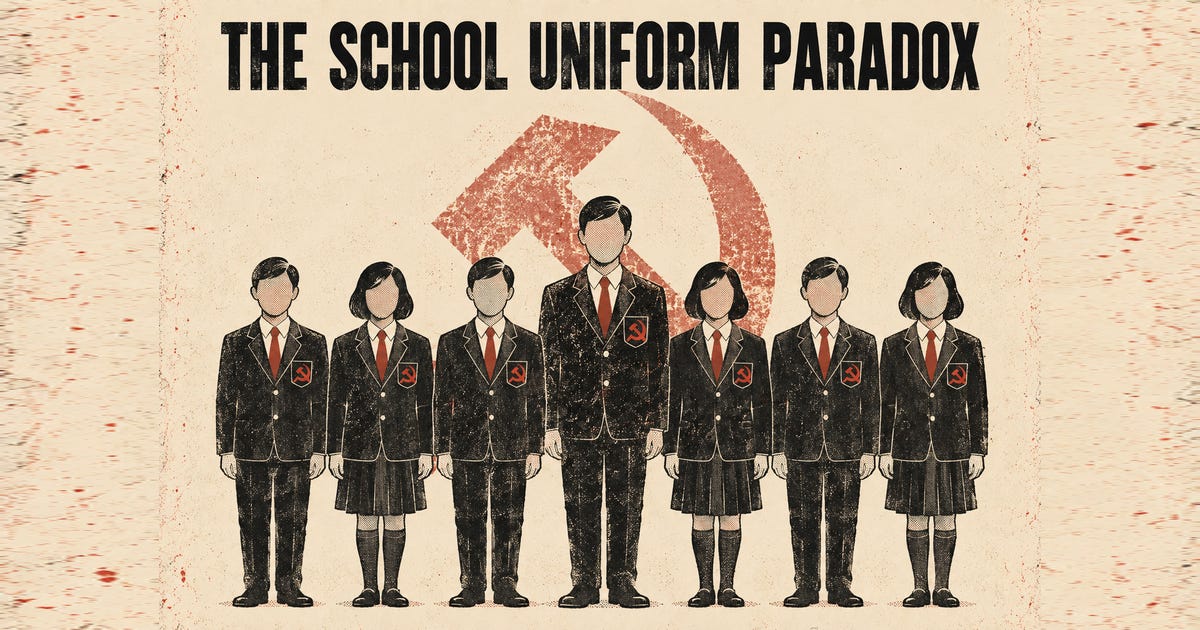
Consider the seemingly innocuous example of school uniforms, what we might call the “school uniform paradox.” The ostensible purpose is egalitarian: eliminate visible class distinctions by making everyone dress identically. Yet the effect is often the opposite. Uniforms simply accentuate “natural” hierarchies based on immutable physical characteristics: height, facial features, physique. When everyone wears identical clothes, these differences become even more pronounced. Conversely, freedom in dress provides social mobility. Someone free to dress as they please can use the money they earn, through work or otherwise, to accentuate whatever they believe will help them move up: they can dress better, buy a gym membership, and improve their appearance. Attempts to enforce equality through rigid uniformity often backfire by amplifying the most arbitrary hierarchical determinants.
The philosopher John Rawls, in reasoning that later inspired luck egalitarianism, argued that the “natural lottery” of genetic inheritance is no more morally deserved than the social lottery of being born into wealth or poverty.[6] “None of us deserves his or her genetics,” as the behavioral geneticist Kathryn Paige Harden puts it, yet these unearned advantages shape life outcomes as powerfully as inherited capital.[7] When a uniformed school crowns the charismatic or beautiful, it has merely swapped one arbitrary lottery (wealth) for another (genes). Justice has not advanced; only the wardrobes have changed.
School also shows the tragedy of the commons at work, and one of its fiercest injustices of equality is the group project. Everyone in the group receives the same grade for the total output, regardless of who did the work, and usually one or two people end up doing most of it while the others drift off. This is especially common in randomly assigned groups, where no strong social trust binds the members together and compels everyone to put in equal effort.
The Uncomfortable Reality of “Natural” Hierarchies
Without economic and state-backed hierarchies, social standing would likely be determined by factors no more just than financial status: interpersonal dominance, assertiveness, charisma, oratorical skill, physical attractiveness, height, muscular development, and raw social capital. These factors have historically formed the basis of pre-capitalist hierarchies, from warrior aristocracies to the elevated status of “sorcerers” and shamans in tribal societies.
Max Weber outlined three types of authority: charismatic, traditional, and rational-legal.[8] When economic hierarchy breaks down, one of these will take its place, and most of the time it is charismatic authority, grounded in presence, oratorical skill, physical superiority, or cognitive skill. Charismatic authority can then be used to establish traditional authority. This is what the sorcerer traditionally did: the shaman class and the priestly class established their authority, usually in a pact with the warrior aristocracy, over everyone else. From there, they could establish their own rational-legal order.
Is there any reason to believe that hierarchies determined by physical attractiveness or charisma are morally superior to those determined by financial status or educational achievement? In fact, they might be worse, leading to even more superficial forms of inequality reminiscent of high school cliques or prison social structures. While oratorical skill might seem more meritocratic than pure physical dominance, the most persuasive speakers are not necessarily the most intelligent or virtuous.
Perhaps the clearest contemporary example of how “natural” hierarchies form in a democratized environment is the internet, particularly social media, where status and influence are distributed based on popularity/audience demand, free of traditional institutional gatekeeping. Success in these spaces is largely determined by the same factors that would likely dominate in a post-capitalist society: charisma, rhetorical skill, physical appearance, and the ability to work social dynamics. The result is not meritocratic but often merely a different form of arbitrary hierarchy, one based on traits no more deserved or earned than inherited wealth.
The Communism-Cult Connection
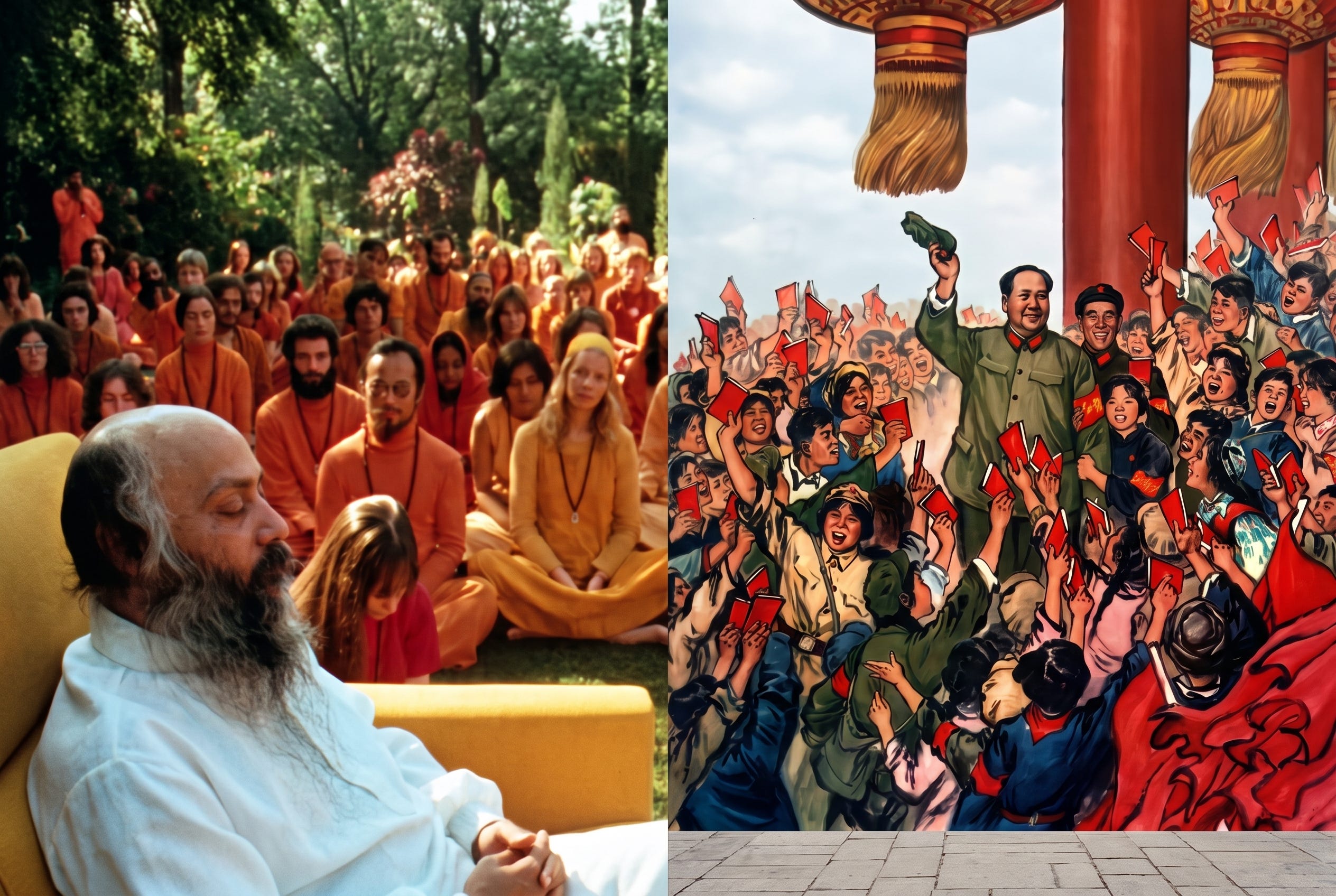
One peculiar phenomenon that bears on the danger of ignoring natural hierarchies is the connection between communism and cult formations. There is a well-documented tendency for many communist organizations and movements to become cults or cult-like, and for many (non-communist) organizations to embrace a “communistic” structure. The pattern is not coincidental. Denying hierarchy creates the ideal conditions for its most pernicious forms.
The school uniform paradox finds its most disturbing manifestation in this phenomenon. Consider the trajectory of spiritual cults that embrace communistic economics. The Rajneesh movement in Oregon abolished private property for commune members, requiring them to transfer all assets to the collective while working without wages.[9] Yet this apparent economic equality masked extraordinary concentration of power. Bhagwan Shree Rajneesh maintained absolute authority through an inner circle that controlled all decisions, operated surveillance systems, and punished dissent. Members surrendered economic freedom for promised spiritual liberation but received neither. The communalistic structure itself became the architecture of total control.
Even more tragically, Jonestown implemented a racially integrated agricultural commune with collective ownership, communal dining, and shared child-rearing, socialist ideals that attracted members genuinely seeking equality and justice.[10] Yet this egalitarian facade enabled Jim Jones to accumulate life-and-death authority over 900 people. The elimination of private property created financial dependency that prevented departure. Communal child-rearing broke family bonds that might have challenged authority. What appeared as radical equality functioned as totalitarian control.
Abolishing formal hierarchical structures doesn’t eliminate hierarchy but makes it invisible and unaccountable. As Jo Freeman observed in her essay “The Tyranny of Structurelessness,” without formal accountability mechanisms, power operates through friendship networks and charismatic authority, making it impossible to challenge without attacking individuals personally.[11] The pretense of equality prevents honest discussion of power, allowing it to operate in shadow.
This dynamic operates equally powerfully in reverse. Communist political organizations, particularly Trotskyist and Maoist groups, have repeatedly developed cult-like characteristics around charismatic leaders despite theoretical commitments to collective leadership. The Workers Revolutionary Party in Britain exemplified this pattern, a supposedly democratic centralist organization where Gerry Healy maintained personal control through purges and systematic sexual abuse of female members that was covered up for years.[12]
Eliminating formal hierarchies doesn’t eliminate the human tendencies that produce them. Max Weber’s theory of charismatic authority explains how individuals with superior communication skills naturally dominate even in movements explicitly rejecting leadership.[13] Time-intensive consensus processes favor those with flexible schedules, typically the economically privileged. Cultural capital determines whose voices are heard and taken seriously. Pierre Bourdieu’s framework reveals how class privilege reproduces itself even in movements dedicated to abolishing class.[14]
The tragedy is that many who join these movements seek genuine community and social transformation. Their idealism becomes the very mechanism of their exploitation. This is not an argument that communist experiments are inherently doomed to become cults, nor that all communists are more susceptible to authoritarian manipulation. Rather, denying the reality of natural hierarchies makes them more dangerous, not less.
Better Hierarchies for Human Flourishing
If we accept that hierarchies may be inevitable in some form, the central question becomes not whether to have hierarchies, but which kind we prefer and how to structure them. This is where my vision diverges both from communist utopianism and from conservative fatalism about inequality.
My ideal is neither communist nor capitalist but rather socialist in the radical social democratic tradition: a society where nobody is too rich and nobody is poor, where nobody is entitled to too much power, and where hierarchies exist but are constantly checked, rotated, and made accountable. This isn’t about eliminating all differences but about preventing those differences from calcifying into permanent castes or accumulating into dangerous concentrations of power.
We should strive for better hierarchies that work best for human evolution and collective flourishing, hierarchies based on genuine contribution, competence, ethical conduct, and civic virtue rather than accidents of birth, whether genetic or economic. No hierarchy should be absolute or permanent. Term limits, transparency requirements, democratic accountability, progressive taxation, wealth caps, and robust social floors all serve to prevent any form of advantage, whether earned or unearned, from becoming tyrannical.
The republican tradition is instructive here: rather than assuming hierarchies will naturally sort themselves into just arrangements, republicanism explicitly designs frameworks to channel hierarchical arrangements toward the public good. This requires an adversarial state and strong institutions that create the conditions for competition based on contribution rather than domination.
The recognition that natural hierarchies intensify when formal ones are removed need not lead to fatalistic acceptance or eugenic thinking. Harden’s anti-eugenic framework offers a path forward that neither denies genetic differences nor allows them to justify inequality. If we truly believe in the Marxist ideal of “from each according to their ability, to each according to their needs,” we must accept that abilities themselves are unequally distributed through no moral fault of individuals.
This suggests several policy implications that go beyond traditional socialist or communist prescriptions. First, we must “raise the floor” for those disadvantaged by the natural lottery, targeting resources where genetic or environmental risk is highest. Universal healthcare, education, and social support become moral and practical necessities for keeping natural differences from hardening into inherited privilege. Second, we must resist the temptation to use genetic information for classification or exclusion, whether through educational tracking, employment screening, or insurance discrimination. Third, and perhaps most radically, we must recognize that the very concept of merit is contaminated by luck, both social and genetic, and design institutions accordingly.
As genetic prediction becomes more sophisticated, the potential for new forms of discrimination grows. Polygenic scores for educational attainment can already predict college completion almost as strongly as family income, with those in the top quartile of genetic variants being nearly four times more likely to graduate than those in the bottom quartile.[15] If communists and socialists remain wedded to the fiction that eliminating capitalism will automatically create just hierarchies based on “true” ability, they risk enabling a genetic aristocracy as pernicious as any we’ve seen. The question is not whether to acknowledge these differences but how to prevent them from determining human worth or social position.
Conclusion: The Question of Choice
When confronting the reality of hierarchies, we must consider the full spectrum of options:
1. Accept financial hierarchies despite their obvious injustices
2. Embrace “natural” hierarchies despite their potentially greater superficiality
3. Return to hereditary hierarchies (aristocracy, monarchy) despite their rigid immobility
4. Pursue the utopian path of eliminating hierarchies entirely, despite its unlikelihood
5. Or recognize the inevitability of some form of hierarchy while deliberately constructing the least harmful version possible
Only by confronting these realities can we move beyond idealistic platitudes about “natural” harmony and begin the difficult work of designing social structures that acknowledge human nature while striving to bring out its best qualities rather than its worst.
While I am critical of the more extreme communist solutions, I have spent the last few years thinking rigorously about the alternatives, and about how we ought to theorize class conflict in the twenty-first century. Class conflict is the one thing I think Marxism rightly emphasizes; its theory of class, however, I believe to be outdated. In its place I offer an alternative theory of class and socialism for our century, inspired by other thinkers as well as by my own unique contributions, which I develop in my book Post-Left Theory: Beyond Marxism, Anarchism, and Vibes, written with David McKerracher of Theory Underground, and above all in my essay there, “Socialism and Class in the 21st Century.” The book comes out October 15.

Works Cited/Footnotes:
[1] Karl Marx, Critique of the Gotha Programme (1875).
[2] Marx, Critique of the Gotha Programme
[3] See, for example, James Woodburn, “Egalitarian Societies,” Man 17, no. 3 (1982): 431–451.
[4] Christopher Boehm, Hierarchy in the Forest: The Evolution of Egalitarian Behavior (Cambridge, MA: Harvard University Press, 1999); Christopher Boehm, “Egalitarian Behavior and Reverse Dominance Hierarchy,” Current Anthropology 34, no. 3 (1993): 227–254.
[5] Niccolò Machiavelli, Discourses on Livy, trans. Harvey C. Mansfield and Nathan Tarcov (Chicago: University of Chicago Press, 1996), bk. 1.
[6] John Rawls, A Theory of Justice, rev. ed. (Cambridge, MA: Harvard University Press, 1999), §12, 63–64.
[7] Kathryn Paige Harden, The Genetic Lottery: Why DNA Matters for Social Equality (Princeton: Princeton University Press, 2021).
[8] Max Weber, Economy and Society, ed. Guenther Roth and Claus Wittich (Berkeley: University of California Press, 1978), 215–216, 241–254.
[9] Win McCormack, The Rajneesh Chronicles (Portland: Tin House Books, 2010).
[10] Tim Reiterman and John Jacobs, Raven: The Untold Story of the Rev. Jim Jones and His People (New York: Dutton, 1982).
[11] Jo Freeman, “The Tyranny of Structurelessness,” Berkeley Journal of Sociology 17 (1972–1973): 151–164.
[12] Aidan Beatty, The Party Is Always Right: The Untold Story of Gerry Healy and British Trotskyism (London: Pluto Press, 2024); Bob Pitt, The Rise and Fall of Gerry Healy, chap. 11, Marxists Internet Archive, https://www.marxists.org/history/etol/writers/healy/pitt/Chap11.html.
[13] Weber, Economy and Society, 241–254.
[14] Pierre Bourdieu, Distinction: A Social Critique of the Judgment of Taste (Cambridge, MA: Harvard University Press, 1984).
[15] Harden, The Genetic Lottery, chap. 1, fig. 1.1, drawing on James J. Lee et al., “Gene Discovery and Polygenic Prediction from a Genome-Wide Association Study of Educational Attainment in 1.1 Million Individuals,” Nature Genetics 50, no. 8 (2018): 1112–1121.
Excellent - the left would make it so much further if they made it to where you are with this.
I think limitarian conservative socialism makes a lot of sense (especially compared to our options now). However, I think some of its framing can be reasonably challenged, particularly from a deep Nietzschean point of view. Yes - many communists and leftists are naive about human nature, believing it to be “good.” Dialectically, the turn-around is to instead believe it is “bad” - that we “naturally” generate these hierarchies and that this is somehow a bad or potentially evil thing, our “original sin,” and therefore we must limit and contain it. This is what Nietzsche critiqued as the nihilism of Christianity and Platonism: positing a transcendent realm of eternal values over and above the immanent realm of appearances and becoming, in which life itself it is always found wanting, and therefore condemned. This is why his philosophy demands absolute affirmation - this life with all of its hierarchy, domination, and suffering should be affirmed and all transcendent values replaced by absolute immanence. That goes too far in my view - it really becomes a recipe for political reaction if taken too seriously. However, I think the left doesn’t take Nietzsche’s challenge seriously enough, and are often afraid of the microscope he puts their values under.
Why should hierarchy be considered “bad” or “evil”? Why even dominance, or suffering? It is considered as such by its victims - the weak and powerless, the resentful. But this genealogy of morals points to the falseness of the claim to universality of the transcendent values championed by the weak. They cannot be universal, but are instead dependent on standpoint, one’s position relative to power.
Unlike Nietzscheans, I don’t believe in the ubermensch who is totally beyond good and evil. I don’t believe in radical perspectivism and the fullness of becoming- I think that dialectics, universality, negativity and lack are extremely important, from Plato all the way to Zizek. However, I think if you take the impartial will to truth of philosophy very seriously, neither the particular nor the universal can be dominant. I believe this leaves us in a state of permanent suspension, confronted continuously with the impossibility of ever settling things one way or the other. You might call it an aporia. But I don’t think that we can ever settle the question of hierarchy or power, and thus the question of socialism never goes away. But it never fully “solves” the issue either. Perhaps viewing politics as a “problem” to be “solved” is a big part of the actual problem. If instead, we are confronted with differences, impossibilities, various hegemonic and anti-hegemonic assemblages, I think that we can avoid some of the limitations of language which tends to put things in mental categories i.e. boxes. In order to recover its vitality, I think that the left needs to escape the prison of language itself and accept that any program it offers is provisional, and that’s what makes the whole emancipatory project creative and worthwhile to begin with - a sense of possibility that has been lost, under the tyranny of “necessity.” The priest’s desire to condemn will always be part of the left - it is necessary to affirm the transcendent. But it must coexist with the desire to escape rigid rules and boundaries. That’s really what the left has not figured out. That’s why it’s divided everywhere: notice that the very bifurcation of anarchists versus Marxists reflects this division and the inability to make the difference productive rather than nullifying. The materials are there to make something new but everyone must relinquish their compulsion to try to control the narrative.
What is the issue with genetic hierarchy if the genes genuinely correspond to useful things?
The problem of bad human nature you bring up as central to the argument seems like something genetic engineering could one day solve