

What Our Book Is About and How To Get It

My new book is now out and available for purchase! Post-Left Theory: Beyond Anarchism, Marxism, and Vibes, which I wrote with David McKerracher of Theory Underground (TU: Thoughts at Work) came out on October 15. This book is a collection of 31 pieces, 16 of them mine and 15 of them Dave’s, plus his introduction and afterword, and you don’t need to read them in any particular order. We first announced this book back in July on an episode of the 1Dime Radio podcast where we explained the notion of the “Post-Left” and addressed all of the most obvious questions about what this book is and what it is not. It’s the only book on post-left theory, and it’s been endorsed by Slavoj Žižek, Angela Nagle and Nina Power. It’s available in paperback on Amazon in most countries and as an ebook straight from the book’s website, and audiobooks are coming soon. Everything is at one link:
Get it here: https://postlefttheory.com
These are works of rigorous theory that aim to make sense of the collapse of the left and why people drift away from it, and the book has some of my spiciest essays yet, including archived material I’ve been sitting on for years. If you read this Substack, watch my YouTube channel or listen to 1Dime Radio, you’ll want this one.
How to get it in any country

Everything is on the book’s website, postlefttheory.com. The paperback is 644 pages and sold through Amazon. The paperback buttons on the site go to Amazon.com, and the “Buy it in your country” section lists the Amazon store for the US, Canada, the UK, Ireland, Australia, Germany, France, Spain, Italy, the Netherlands, Belgium, Poland, Sweden and Japan. If your country isn’t listed, Amazon.com ships internationally, and searching any Amazon store for the ISBN, 979-8193078067, will also find it.
If you’d rather read it digitally, or you’d rather not buy from Amazon at all, the ebook comes straight from us: a DRM-free PDF or EPUB for $18, or both for $22. It’s available anywhere in the world, you can download it right after checkout, and there’s an option to add a tip for the authors. The site also has an excerpt from Dave’s introduction, “What They Called Post-Left vs. What We Call Post-Left,” and the book’s full index, so you can look inside before you buy.
What this book is
This book is a collection of our essays organized around an overarching theme. Some of the essays in the book have been published here on my Substack already, but many of them haven’t, most notably some of the spiciest ones: “The Phantom of Patriarchy,” “The Cosmopolitan Delusion,” “The Leftist Industrial Complex,” “The Self-Contained Opposition Factory,” “Marxism as Accelerationism,” “Actually Existing Marxism” and many more, including my favorite of them all, “The Suicide of the Left.” A lot of this is brand-new material.
Sneak Peek of The Table of Contents
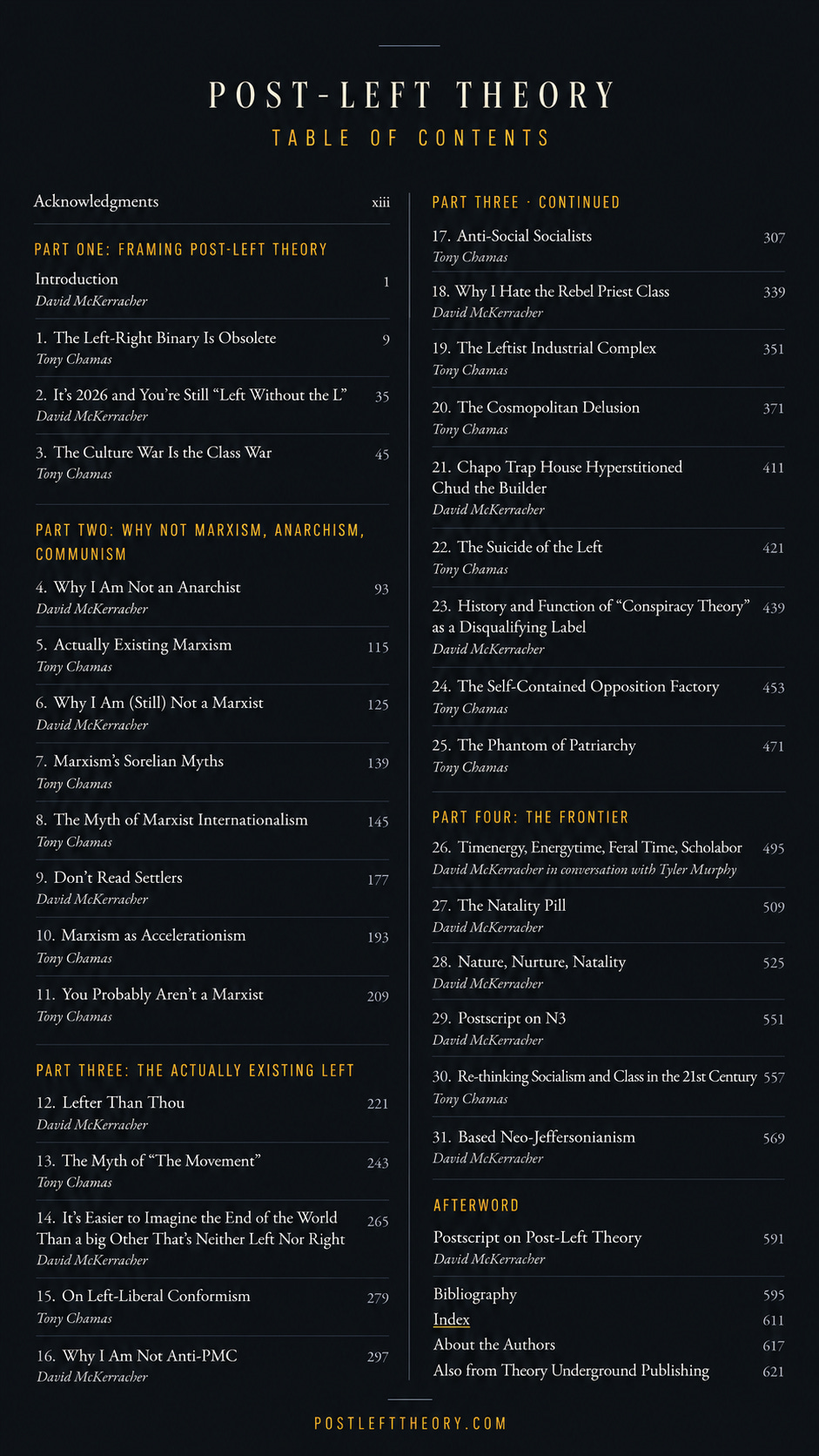
Together, the essays encompass the broader theme of post-left theory. What distinguishes that theory, and the theoretical work Dave and I are doing, is that it breaks from the left’s big Other, which Dave describes in his introduction as “the imagined authority whose approval you are unconsciously working to win, the audience in your head that quietly sets the outer limit of what you are permitted to think.”
It truly is neither left nor right, in the sense that it doesn’t exclude itself from either side. We tend to lean left in some ways and conservative in others, and I might lean more left than Dave does. In the introduction, Dave describes me as someone who still writes to the Left, documenting “what the Left would have to understand to become a majoritarian force again,” while he writes about it “the way you write about a country you’ve emigrated from.” As he puts it, “This tension could be read as the co-authors disagreeing about what the book is, but I argue it is the opposite: it is the book’s engine.”
In any case, the whole point is that the book is organized around these broader themes, in four parts: Framing Post-Left Theory; Why Not Marxism, Anarchism, Communism; The Actually Existing Left; and The Frontier. As Dave explains in his introduction, we settled on the title Post-Left Theory because “while there have been ‘Post-Left’ figures and moments, there has never been a concerted effort to understand the situation from a genuinely post-left position.” Reaching a political synthesis adequate to the present means getting beyond the binaries of Left and Right altogether, and that is the work of the essays Dave and I have collected here. In the words of the book’s own description:

Post-Left Theory does not present a program for a movement. This is not a manifesto. Within these pages will be found no grand solutions, no prefabricated identity for consumers to wear. What this book supplies its reader is something more akin to a grenade to detonate one’s presuppositional coordinates. The disagreements within and between the pieces in this volume will force you to carve out your own position, and it will be your own, because you cannot read this book and walk away the same. Free yourself from the Party Line, the checkboxes of what can or cannot be said, and the cloistered confines of a captured dead end. What opens here is a horizon on a frontier. Come explore.
You don’t have to read it all at once, or in any order
Don’t let the 644 pages put you off. You don’t have to read this book all at once, and you don’t have to read it front to back. You can start with whichever essay strikes you as most interesting and read the rest in any order you like. You don’t have to read all of the essays, either. Read it at your own pace.
With Endorsements From Žižek, Nagle and Power
We’re honored to have these endorsements. Here is what each of them said.
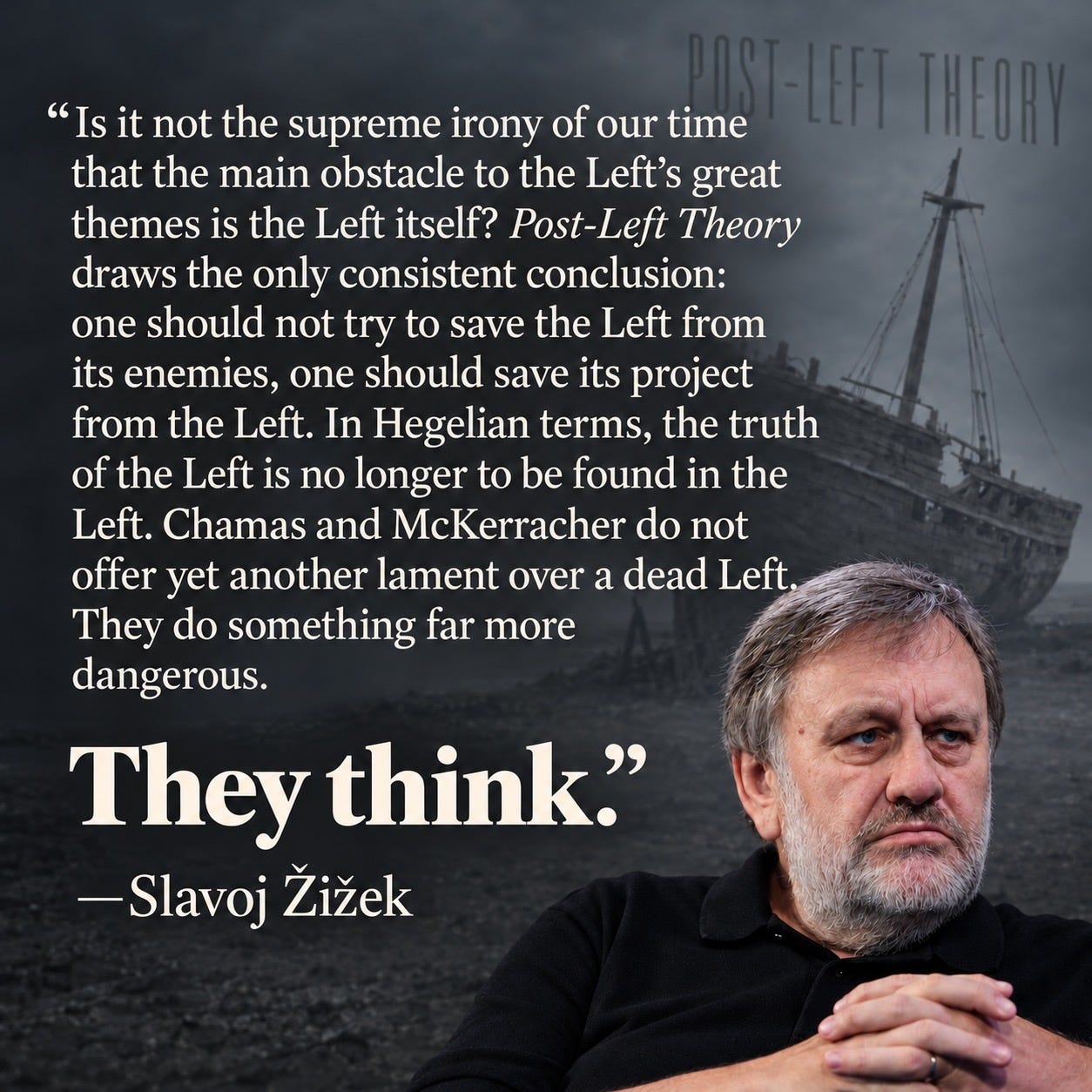
“Is it not the supreme irony of our time that the main obstacle to the Left’s great themes is the Left itself? Post-Left Theory draws the only consistent conclusion: one should not try to save the Left from its enemies, one should save its project from the Left. In Hegelian terms, the truth of the Left is no longer to be found in the Left. Chamas and McKerracher do not offer yet another lament over a dead Left. They do something far more dangerous. They think.” - Slavoj Žižek

“Post-Left Theory opens with a first essential step of rejecting the Left’s authority. What becomes possible when we cease to grant the Left any authority, yet continue to explore the great themes it poisons and gatekeeps, like leisure, fulfilling work, production and ownership? Chamas and McKerracher bring two approaches into dialogue, reconstructing socialist politics and moving beyond the Left’s framing altogether. For me, that intellectual freedom is the essential starting point that postmortems of the Left never reach. With a spirit of creative freedom, the book explores what remains worth aspiring to.” -Angela Nagel

“In reading Post-Left Theory, I hope you will come home to your mind! Reclaim and protect all that you love: your imagination, judgement, and powers of discernment above all.”- Nina Power
My five favorite essays
If you’re not sure where to start, start with these. They’re my five favorites, and all five are in Part Three, The Actually Existing Left.
“The Suicide of the Left” Cultural Progressivism as an Ideology of Late Capitalism
The usual story about the left’s failure is one of political murder: it was killed by McCarthyism, crushed by capital, infiltrated by the state and betrayed by timid liberals. There is a rational kernel of truth in those stories, but they don’t explain why the left keeps choosing ideas that estrange it from the people it claims to represent. My thesis is that the left was not simply defeated; it killed itself. Cultural leftism gained institutional influence at precisely the time left-wing economic agendas lost theirs, so the Overton window moved left on culture and right on economics, and cultural leftism fit the individualist consumer logic of late capitalism, even helping to accelerate it by becoming a core part of the dominant ideology. The title is a triple entendre: the suicide of the left as a political force, the civilizational suicide it helps rationalize, and, partly metaphorically, the suicide of leftists themselves, with self-destructive ways of living recast as politics, identity or liberation. The essay is written for the leftists who want to build a better society, not the ones who want to destroy this one in the hope that something better follows: “It is not an obituary for the left or a celebration of its enemies. It is a warning to a movement that has confused despair with insight, negation with radicalism, and destruction with change.”
“The Cosmopolitan Delusion” The Sociology of Liberal-Left Obliviousness
Why are leftists and liberals out of touch on so many of the same popular concerns, from mass migration and globalization to the reaction against the excesses of social progressivism, all of which they have largely ceded to the populist right? My answer is that the rootless cosmopolitan experience is central to it, and that on immigration above all, they are blinded by their own rootless cosmopolitanism. I know that term has an ugly, antisemitic history, and the essay confronts that history head-on, because I mean something very different from what the far right means by it. I am naming a sociological type that cuts across religions and ethnicities, anchored in class position, education and life experience: a professional-managerial and symbolic elite whose material conditions, social circles and moral outlook detach them from the everyday attachments, insecurities and grievances of most people. From there the essay works through the urban-rural and education divides, globalism as a luxury belief, and who actually benefits from immigration. As I put it in the conclusion, “The point of this essay is not to side with xenophobes against migrants, or with cosmopolitan elites against rooted peoples.” Both the liberal fantasy of a borderless world and the far-right fantasy of an ethnically purified nation are dead ends, and the rootless cosmopolitan “mistakes having no roots for having access to the universal, when the universal only exists in and through the particular: one cannot truly become a “citizen of the world” just because they are anti-patriotic.
“The Phantom of Patriarchy” The Function of Actually Existing Feminism Today
Patriarchy is still discussed on much of the left as if it were an ever-present specter hanging over Western society, usually without anyone stopping to define what they mean by it. The same goes for feminism. Feminism means many things to different people and has evolved considerably throughout history, with various factions that have incompatible differences. This makes feminism a very hard thing to generalize and difficult to critique because people can always say feminism means whatever they want it to mean to dodge certain questions. However, there is what we might call a general actually existing feminist ideology that has become hegemonic in the mainstream, ironically right at the time in which the framings of its discourses become obsolete.
In left-liberal environments in particular, the hegemonic power of generalized feminism has narrowed the confines of acceptable discourse when it comes to certain questions and has made the premises which guide its discourse difficult to question. Questioning whether the West is still meaningfully patriarchal gets treated as if it were the same as denying that sexism, misogyny, or discrimination still exist, but those are two different claims. Women obviously still face problems, and we must recognize that it is possible for a society to still have widespread misogyny and injustice despite no longer being characterized by “patriarchy” in any real sense. In some ways, especially for mothers, women are worse off than before despite the fact that incomes have levelled and women have completely outperformed men in educational credentials (with way more women earning college degrees than men do). The serious question is what institutions, laws, and material relations actually make our social order patriarchal in any historically meaningful sense. Drawing on the French historical anthropologist Emmanuel Todd, and a wide range of sources, I look at what patriarchy actually was, how & when the systemic institutions we call patriarchy declined, why people pretend it still exists in the Western world, and what replaced it: a post-patriarchal liberal-capitalist system. I call it a system with “patriarchs without patriarchy,” because the fact that society is still controlled by a handful of wealthy powerful men is the reason why it may still appear to many women that there is a “patriarchy.” I also get into what wage-gap discourses miss and why they cannot explain the real reasons for the persistence of male-female inequality at the very top echelons of capitalist society despite the countless state-mandated DEI initiatives to close the gap.
Now I know what you're thinking: this essay is not an argument for somehow rolling back the wheel of history and restoring patriarchy. Rather, the purpose is to interrogate the following question: why, precisely at the moment where systemic patriarchy has virtually been erased in Western countries, has there been a rapid rise in female identification with feminism and increasingly antagonistic feminist discourses about “fighting the patriarchy” ever since around 2012? Most importantly, what does this paradox say about the function that actually existing feminism in mainstream discourse plays in maintaing the neo-liberal status quo? This is one of the most serious contradictions in society that leftists are too afraid to touch, and their inability to be honest about these problems is why they fail to understand the global gender war, and why left-wing politics does not resonate with younger men (and increasingly, older women too).
Frankly, this whole topic can make you a pariah on the modern left if you seek to cater to PC liberal women. Most people who claim to be “feminist” have not read any feminist theory, nor could most tell you the differences between each wave of feminism throughout history. Not to mansplain feminism, but this is why relying on this or that feminist theory to defend or fully denounce feminism is a pointless endeavor. Feminism, in the general sense, has become synonymous with simply caring about the issues that concern women. But once you realize that there is no such thing as a single coherent ideology called “feminism” that actually represents the views of the silent majority of women, you are freed to actually think what is possible beyond the binaries of reactionary manosphere and the feminist industrial complex.
“The Leftist Industrial Complex” The Incentives That Drive the Vampire Castle
Watch what happens when someone on the left offers even the mildest criticism of their own side. Within hours, the criticism is no longer being discussed; the critic is. This essay explains why, building a more economic and sociologically grounded theory of the phenomenon in political echo chambers that Mark Fisher called “the Vampire Castle.” The leftist industrial complex is the term I use to describe the market niche of left-wing political media and the various market-driven incentives that subconsciously and consciously dictate many of the behavioral tendencies we see on the left (like cancel culture, political correctness, wokeism, etc..) that people often mistake as a problem of “compassion” or good vs bad leftists. More importantly, I argue that this leftist industiral complex does not represent propaganda for any “movement” but rather a consumer product & identity that cultivates a self-perpetuating ecosystem of impotent self-contained opposition, an idea which I elaborate on in “The Self-Contained Opposition Factory” essay. There is indeed a right-wing media industrial complex as well, evangelical christian industrial complex, and other similar things, so this tendency is by no means exclusive to the left. However, what makes it unique is that leftists tend to be much more unaware of their own industrial complex that they consume from and/or participate in. Many leftists tend to take “the discourse” in this ecosystem to be part of a general movement that they think of as “the Western left” and when consuming media, they often mistake intra-symbolic capitalist competition for genuine “leftist-infighting.” In the leftist industrial complex, Creators compete for attention inside a niche audience, algorithms reward engagement, subscribers reward affirmation, and professional networks punish anyone coded as reactionary or unsafe. Each person may be acting rationally, but together they produce an opposition with no incentive to understand or appeal to anyone beyond itself. “This is why the movement can decline while the industry grows.” Along the way I ask, “If the working class has no voice, whose voice are we hearing when left media claims to speak for it?” The last section asks: “How many times must you lose before you ask whether you are playing the game wrong?”
“The Self-Contained Opposition Factory”
When opposition in a democracy seems reliably neutralized, the most common explanation is conspiratorial: somebody is pulling the strings. My alternative is a theory I call contained opposition, which I first formulated in my master’s thesis at York University, explored in my video essay “Controlled Opposition” on the 1Dime channel, and develop most fully in my forthcoming solo book with Sublation Media, Freedom to Change Nothing: A Guide to Modern Managed Democracy which is my solo book that I have been working on for nearly 4 years and announced on my channel nearly 2 years ago.
The rest of my essays
Those five are only part of my half of the book. In Part One, “The Left-Right Binary Is Obsolete” asks what “leftism” even means today, and “The Culture War Is the Class War” lays out my theory of the two lefts. That one is also the fourth and final essay in my Genealogy of Wokeism series, though you don’t need to have read the earlier parts. Part Two collects my essays on Marxism: “Actually Existing Marxism”; “Marxism’s Sorelian Myths,” on communism as a faith for the faithless; “The Myth of Marxist Internationalism”; “Marxism as Accelerationism,” on how communism accelerated capitalism; and “You Probably Aren’t a Marxist,” on why “old leftists” are post-leftists in denial. Alongside my favorites in Part Three, “The Myth of ‘The Movement’” proposes a new political strategy, “On Left-Liberal Conformism” looks at thought taboos and subconscious self-censorship in urban-progressive spaces, and “Anti-Social Socialists” is about how the left became a freak show. All three of those, along with both of my Part One essays, started here on 1Dime Review.
My last essay in the book is “Re-thinking Socialism and Class in the 21st Century.” Class conflict is the one thing I think Marxism is correct to emphasize; its theory of class, however, I believe to be outdated. In its place I offer an alternative theory of class and socialism for our century, which I develop above all in that chapter.
Dave’s chapters
Dave, the founder of Theory Underground and author of Timenergy, wrote the introduction, the afterword and 15 chapters. They include “Why I Am Not an Anarchist,” “Why I Am (Still) Not a Marxist,” “Don’t Read Settlers,” “Lefter Than Thou,” “Why I Hate the Rebel Priest Class,” “Chapo Trap House Hyperstitioned Chud the Builder,” “The Natality Pill” and “Based Neo-Jeffersonianism,” plus a conversation with Tyler Murphy on timenergy and scholabor.
Dave and I on 1Dime Radio: “The Post-Left Frontier”
To celebrate the release, Dave joined me on 1Dime Radio for an episode called “The Post-Left Frontier.” We preview some of the essays in the book, challenging the sacred cows of the contemporary left, from Marxism and anarchism to wokeism, feminism, gender relations, and the limits of left-wing politics, and we talk about why you should read the book and the topics that are forbidden on the left. We also reflect on our experience at TUCon and CanonFest, discuss the crisis of modern intellectual culture, and introduce Dave’s new philosophy trading card game, Canon: TCG, including my adventures collecting and trading rare Hegel, Freud, and Leo Strauss cards. You can listen to it here on Spotify, YouTube, and all podcast platforms.
What’s inside the book (Another look at the table of contents):
Part One: Framing Post-Left Theory
• Introduction, David McKerracher
• 1. The Left-Right Binary Is Obsolete, Tony Chamas
• 2. It’s 2026 and You’re Still “Left Without the L,” David McKerracher
• 3. The Culture War Is the Class War, Tony Chamas
Part Two: Why Not Marxism, Anarchism, Communism
• 4. Why I Am Not an Anarchist, David McKerracher
• 5. Actually Existing Marxism, Tony Chamas
• 6. Why I Am (Still) Not a Marxist, David McKerracher
• 7. Marxism’s Sorelian Myths, Tony Chamas
• 8. The Myth of Marxist Internationalism, Tony Chamas
• 9. Don’t Read Settlers, David McKerracher
• 10. Marxism as Accelerationism, Tony Chamas
• 11. You Probably Aren’t a Marxist, Tony Chamas
Part Three: The Actually Existing Left
• 12. Lefter Than Thou, David McKerracher
• 13. The Myth of “The Movement,” Tony Chamas
• 14. It’s Easier to Imagine the End of the World Than a big Other That’s Neither Left Nor Right, David McKerracher
• 15. On Left-Liberal Conformism, Tony Chamas
• 16. Why I Am Not Anti-PMC, David McKerracher
• 17. Anti-Social Socialists, Tony Chamas
• 18. Why I Hate the Rebel Priest Class, David McKerracher
• 19. The Leftist Industrial Complex, Tony Chamas
• 20. The Cosmopolitan Delusion, Tony Chamas
• 21. Chapo Trap House Hyperstitioned Chud the Builder, David McKerracher
• 22. The Suicide of the Left, Tony Chamas
• 23. History and Function of “Conspiracy Theory” as a Disqualifying Label, David McKerracher
• 24. The Self-Contained Opposition Factory, Tony Chamas
• 25. The Phantom of Patriarchy, Tony Chamas
Part Four: The Frontier
• 26. Timenergy, Energytime, Feral Time, Scholabor, David McKerracher in conversation with Tyler Murphy
• 27. The Natality Pill, David McKerracher
• 28. Nature, Nurture, Natality, David McKerracher
• 29. Postscript on N3, David McKerracher
• 30. Re-thinking Socialism and Class in the 21st Century, Tony Chamas
• 31. Based Neo-Jeffersonianism, David McKerracher
Afterword
• Postscript on Post-Left Theory, David McKerracher
Book details
• Paperback, 644 pages, on Amazon in most countries
• Ebook: DRM-free PDF and EPUB, direct from postlefttheory.com
• Audiobook: coming soon
• Published October 15, 2026, by Theory Underground Publishing
• ISBN (paperback): 979-8193078067
One favor
If you read it, please leave a review on Amazon. Reviews are how a small-press book gets found.
Get your copy:
https://postlefttheory.com
Your support helps keep my entire 1Dime project alive and independent! Support my work on Patreon to get access to over 100 exclusive episodes of the 1Dime Radio podcast and private Discord access.