

Who Is Really a Communist?
This short essay is a quick follow-up to Why I Am Not a Communist. In that essay, I explained, at the level of principle and ideology, why I am not a communist, and I argued that most people wouldn’t be either if they took communism’s ideas and their implications seriously. Here I want to analyze a more interesting question. Why do so many people who are not actually communists present themselves as communists, or as something very close to it, when, if they were honest with themselves, they would admit they are nothing of the kind? Why latch onto the label at all?
I should be precise about the kind of people I am talking about, because it is not one type but two. The first calls himself a communist outright while holding none of the belief that would make him one. The second never claims the word but flirts with it, implies it, signals it, most often by calling himself a Marxist, while holding nothing that resembles communism’s actual goal. By the definition I defended in the earlier essay, a communist is a person who believes, at least as a final horizon, in a stateless and classless society. Neither type believes this. They are market socialists, state socialists, or social democrats with no real quarrel with the state and no expectation of its disappearance. And since Marxism takes communism as its horizon, the second type, if he were honest with himself, would have to concede that he is not really a Marxist either.
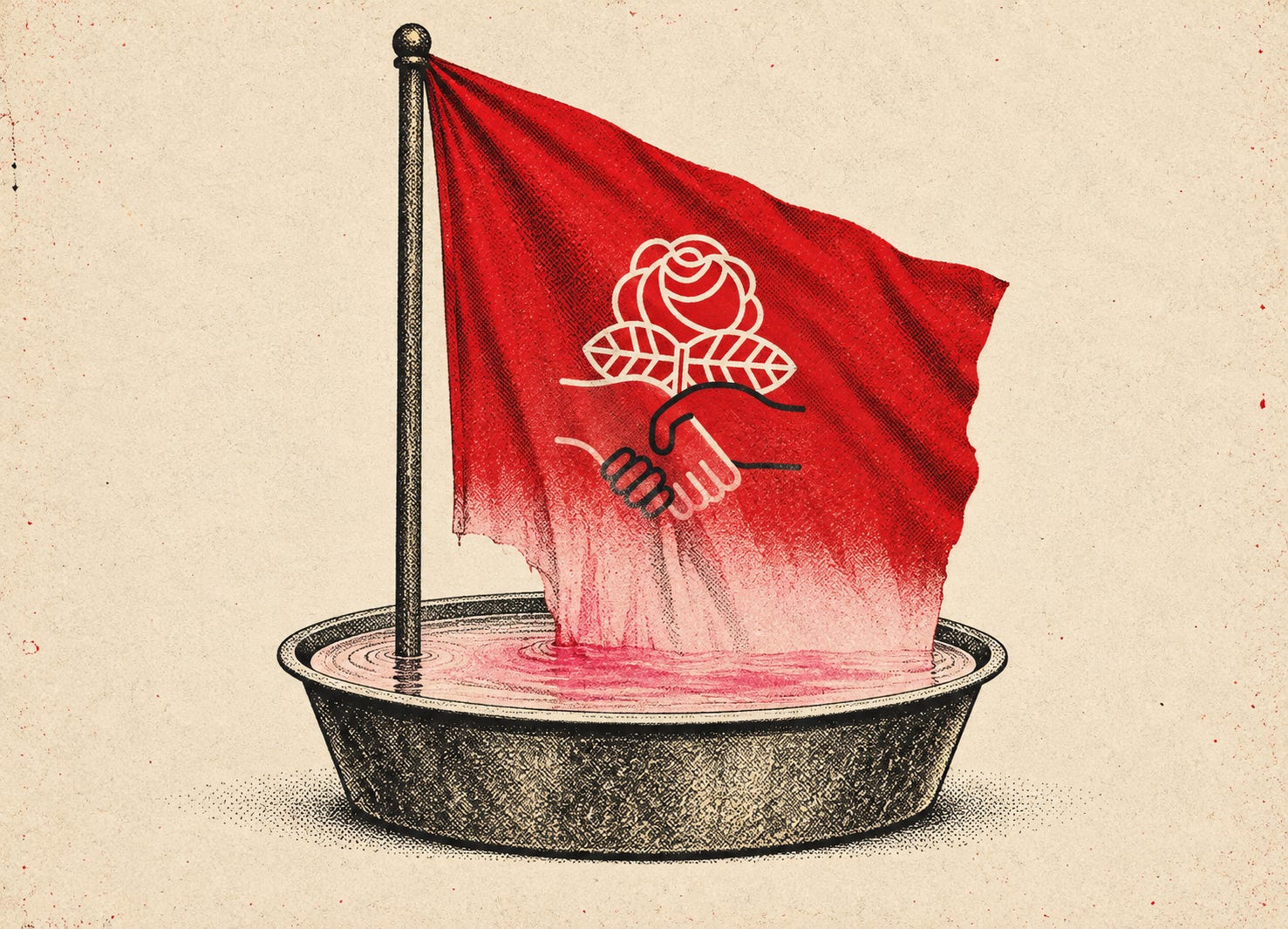
There is an old American word for this figure: the pinko. It rests on a simple observation, that pink is red diluted, and it names exactly the person who is too red for a mainstream that recoils at the word yet not red enough for the committed, who can see at once that the belief behind it is missing. I want to reclaim the word, and I should say plainly in what spirit. The McCarthyite red scare used pinko as a weapon, to tar every socialist as a communist in hiding. I mean the reverse: to help those who are not communists stop blurring the line themselves, and stop making themselves so easy to hunt.
None of this is said in contempt. I was a pinko myself once, as many, though by no means all, on the left have been, and the sympathy is natural, even generous in its impulse. There is an old dictum, usually mangled in the retelling, that whoever was not a communist sympathizer in youth has no heart, and whoever remains one in adulthood has no brain. As I've said before, I understand the appeal of communism very well, and I do not think that all communists are fools. But there is a reason why most former communist sympathizers eventually grow out of it. Bernie Sanders honeymooned in the Soviet Union and spent part of his youth on a kibbutz, and was for a season a genuine sympathizer; what redeems the story is that he later left the sympathy behind entirely, as one should.
The trouble is the pinko who never does. Because he sympathizes without ever having interrogated the premises of the creed, its final goal, or what pursuing it would actually entail, content to call it merely unrealistic and leave it there, he never draws a firm line between himself and the communist, and so he reads as a communist in social-democratic clothing, a man for whom the real program has merely been postponed. This is what earns the modern democratic socialist the suspicion of running a Trojan horse, of carrying water for a revolution he declines to name. It is also how a mild sympathy curdles into something harder. When reformist movements stall, as they reliably do, the disillusion they leave behind is gathered up by revolutionary ones, which recruit the young, the disenchanted, and those who never quite found a seat in the respectable organizations of the left.
Most “Communists” Are Not Actually Communists
How does a person end up here? The most immediate answer is that communism, or Marxism, has become for many little more than a more radical way of saying socialist. Ever since the neoliberal turn of many of Europe’s social-democratic “socialist” parties, and the recent rise of “Democratic Socialist” politicians such as Alexandria Ocasio-Cortez and Zohran Mamdani, the word socialism has been so thoroughly diluted that it now stretches to cover almost any enlargement of the welfare state, and figures who are at most moderate social democrats are routinely filed under it. A term that once named a definite project has softened into a mood, a vague approval of the government doing more. Those who wish to mark themselves as something sharper therefore reach past socialism for the more forbidding word, or for its respectable cousin, Marxist. Slavoj Žižek is the clearest case: a thinker who plainly does not expect the state to wither, yet who clings to the communist label precisely as a protest against the hollowing-out of socialism, and who has been rebuked by actual communists for doing so. In his hands, as in many others, the word works less as a description of a society one hopes to build than as a signal of distance from the merely respectable left.
The quieter version is commoner still, and it is strongest among leftist academics and intellectuals: socialists rather than communists who nonetheless decline to say so cleanly, whether from fear of alienating a base more radical than they are, or because they have never genuinely worked out why they reject communism and wave it away only as unrealistic. Loud or quiet, the move seems to me a mistake, and not merely an inaccurate one. To answer the dilution of one word by inflating another is to make a moderate position sound far more alarming than it is, alarming above all to the very people one would need to win over, while gaining nothing in precision. Whatever the motive, whether vanity, loyalty, or private disappointment with what socialists have done in power, the ambiguity serves no one. If a person is in truth a social democrat or a democratic socialist, the honest course, and the more effective one, is to say so plainly and to leave the words communist and Marxist to those who actually mean them.
There is something perverse in the whole performance. A person hoping to build a majority ought to make his position sound less frightening than it is; the pinko insists on making it sound more. The inflation is can be driven by a genuine communist sympathy as well as a bit of hipsterification, a bid to appear more edgy, transgressive, and to distinguish oneself from the “mainstream” socialists. Its not cool enough to advocate for just boring old democratic socialism, because that’s just for “socdems” (a shorthand for social democrats) according to the radicals. So often times the moderate socialists is driven to become a Pinko by dipping himself in red in order to be counted a real radical within the socialist in-group rather than one of the timid reformists. But while flirtation with communist ideology may rally up young radicals and communist-sympathizing academics, it can at the cost of needlessly alienating the majority of people who aren’t already leftist radicals. Lots of polling data suggests that “socialism” is far less scary to people compared to communism. Gallup now puts socialism’s favorability among Americans at 39 percent, and a clear majority of Democrats view it more warmly than capitalism, a share that has climbed steadily since 2010. Communism has enjoyed no such rehabilitation: a Cato/YouGov survey finds only 14 percent of Americans favorable toward it. The same people who have warmed to the one word recoil from the other, so to reach for communism while meaning socialism is to court the recoil and gain nothing by it.
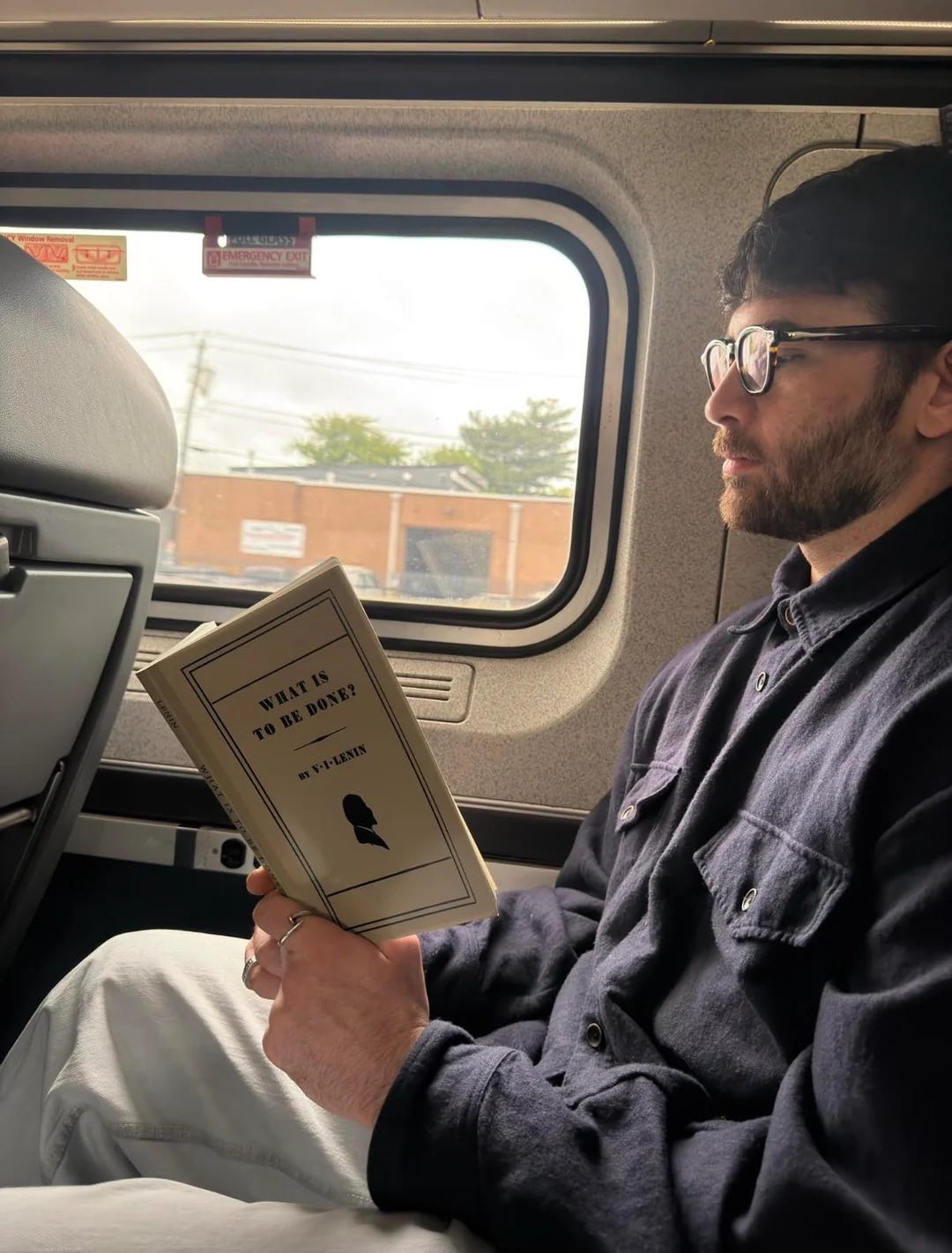
When it comes to examples of Pinkos, the clearest living specimen is Hasan Piker. His actual politics sit a short walk from Bernie Sanders, and his real ambition is to pull the Democratic Party toward the left and beat the Republicans, which is a decent enough aim. Yet he dresses it in red: the language of comrades, the defense of Marxist-Leninist states, the appearances on communist podcasts where he plays along, when his real goal is clearly to convince the Democratic Party to adopt more socialist policies. He is ultimately a Bernie bro with communist sympathies, which makes him transgressive in the eyes of younger, newly radicalized socialists who are disenchanted (rightfully so) with the Democrats. Were he to say plainly what he is, a democratic socialist, his opponents would struggle to paint him as a dangerous extremist; instead he supplies the portrait himself, appearing more radical than he really is. He occasionally invokes communist lingo, Marxist-Leninist iconography, posts pictures of himself reading Lenin’s State and Revolution, all while ultimately advocating for the Democratic Party to merely adopt the kind of policies advocated by Bernie Sanders.
All that said, I am far from a Hasan Piker hater. I find the right’s preoccupation with him rather fascinating, because he is not at all dislikeable in the way that many of the classically annoying “social justice warrior” type of leftists are. He reminds me of some frat dudes I was friends with in college, but quite a bit smarter, to Hasan’s credit. Judged by the standards of any streamer, he is by far one of the better ones, and anyone who talks for a living around the clock, five days a week, is bound to say some dumb things. Frankly, I think much of the hatred aimed at him is driven by jealousy: he is unapologetically a champagne socialist who happens to be handsome and wealthy, while committed to left-wing causes all the same. My criticism of Hasan is mainly that he presents himself as more radical than he needs to be, and that he, like most other leftist creators, is not immune to audience capture, which I suspect pulls him, without his quite noticing, into the same traps of the leftist industrial complex that I have criticized at length in my Substack essays and in my book Post-Left Theory with David McKerracher of Theory Underground. A trap Hasan Piker may find himself in is trying to fill the expectation of being the “voice of the left” in which he may struggle to appease both the far-left larpers in his audience while taken seriously enough to influence serious people actually trying to do politics capable of winning elections on a large scale. Pinkos do themselves a disservice when they fail to distance themselves from the far-left extremists, whose stated goals, like communist revolution or the balkanization of America, they have no intention of actually pursuing. I have always wondered why more non-communist socialists/leftists don’t draw harder lines regarding where they stand on the political spectrum. But the more I started criticizing communism as someone who was once expected to be a “leftist influencer,” the immense backlash I received from the loud minority of radicals made me understand why many people on the left don’t attack that beehive. A lot of people who still believe in the idea of “the left” and “leftism” as coherent things (which I deconstructed in my essays on The Myth of the Movement and The Left-Right Binary) end up associating themselves with a lot of extreme people and stupid ideas that are completely incompatible. This outdated popular-frontist belief in “the left” as a movement of different leftist factions that somehow need to unify beyond their ideological disagreements is part of what leads to the Pinko tendency.
Many people in the DSA also exhibit the Pinko tendency, its chair and leaders included. They talk about revolution and seizing the means of production when, if they are honest, they have no intention of doing any of it. They invoke Marx and Lenin and like to imply a vague, long-term communist horizon when they themselves are not really communists. It is not taken as a real threat by the establishment because it ultimately comes across as unserious, and it just scares away too many normies.

The DSA itself is difficult to generalize. Its a big-tent organization, internally diverse, made up of chapters that run semi-independently across different cities and states, each with its own tendencies. Not everyone in it is a pinko. Even so, much of what I am about to describe can be seen in a recent New Yorker Radio Hour interview with one of its national co-chairs, because the pinko tendency runs through the organization for reasons that are structural rather than accidental. It is shaped overwhelmingly by student activism, drawn from precisely the population with the free time, and the disposition, to be pulled toward this sort of politics in the first place.
In DSA circles, the Pinko tendency often manifests in the awkward concoction of woke liberal PMC attitudes with the LARPy revolutionary communist rhetoric of lumpenized, under-socialized students. It is the fusion of two idioms that ought to be incompatible: the woke, human-resources language of the liberal professional-managerial class, the sort one hears in ordinary Democratic Party circles, and the larpy revolutionary communist rhetoric of lumpenized students. Communist iconography and woke iconography do not actually belong together, yet in the DSA they are constantly forced into the same sentence. You will find the language of police abolition and anti-imperialist revolution sitting beside the language of ableism, wellness, and fitness culture, the vocabulary of the seminar room and the human-resources department. It is on open display at the conventions and conferences, where anti-capitalist slogans share a room with the kind of woke HR lecturing you would find in the worst corners of the Democratic Party. It is also why what looks, as I argued in my essay on the culture war, like a fight between the radical left and the moderateleft is often nothing of the sort. Both camps are frequently drawn from the same professional-managerial stratum, and the radicalism is largely a matter of vocabulary.
Where I can partly sympathize with the Pinko tendency is due to the weaselly limp-dickness of the “moderate” liberal-left, which can be so spineless and captured by HR Professional-Managerial Class minded people who are terrified to entertain any ideas that might seem too scary according to their polling data. This is how I felt about much of the mainstream left in America and Canada (especially the NDP), and my disenchantment with that as early as 2016 was what initially drove me to explore what was going on in the communist scene and more far-left circles in general.
I have already said all that really needs to be said about the “tankies,” anarchists, and ultra-woke libertines in my past work. My beef in this critique here is not with the real communists, some of whom I respect. It is with people who pretend to be communists when they are not. I bring real Marxists onto my show, thinkers of the caliber of Chris Cutrone and Ted Reece, because the tradition is a serious one and deserves to be argued with in good faith, even by someone who stands outside it and aims to go beyond it to look for something that actually works in the 21st century. I have more respect for a rigorous and fully committed Marxism, mistaken as I judge it to be, than for a watered-down communism that borrows the tradition’s glamour and skips its convictions. The genuine communists I have spoken with, some of whom have worked inside the DSA, know quite well that most of the organization does not share their worldview, and there is an honesty in that knowledge which the pinko never manages.
Communists vs Socialists
All of this raises a deeper question: why does the word communist carry the charge it does, and why does socialist not? In Marx’s own usage, socialism and communism were not rival camps but successive phases of a single process, the first a transitional order in which the state still stood, and reward still answered to labor, the second the stateless and classless condition into which the first was meant to dissolve. The division between “socialists” and “communists” crystallized after the Bolshevik revolution. When Lenin’s faction, long since split from the Mensheviks, renamed itself the Communist Party in 1918, it did so to break cleanly from the socialist parties of the Second International, and the difference it proclaimed was one of method far more than of doctrine. Kautsky, the so-called Pope of Marxism, laid the distinction out at length in Communism and Socialism (1932), treating the divide not as a disagreement over ultimate ends but as a clash of methods, the democratic against the dictatorial. From that point onward, communism named a particular road: the capture of power by a revolutionary vanguard, and the dictatorship of the proletariat as the vehicle of transition.
This history is what lends the popular caricature its rational kernel. When people say that socialism is when the government does things and communism is when the government owns everything, they are registering, however crudely, something real: that socialism, as it was actually built by communist parties, came to mean forced collectivization and the absorption of the whole economy into a one-party state. The same logic surfaces today in a revealing hypocrisy. In radical circles one regularly meets Marxist-Leninists who pronounce China socialist while dismissing Norway as a mere social democracy. Norway, to be clear, has never pretended to be socialist; it is a social democracy and calls itself one, even if many of its policies are of the kind commonly associated with socialism. The inconsistency lies elsewhere. China, whatever one calls its system, is by most measures the more thoroughly capitalist of the two, a state capitalism far more hospitable to private accumulation and market discipline than any Scandinavian welfare state, and, as I showed in the 1Dime documentary on how China works, its welfare state and its workers’ rights are, ironically, less socialized than Norway’s. That the same people will champion the more capitalist country and disdain the less capitalist one, whatever China is actually doing in its governance, can be explained by a single fact: China is ruled by a communist party, and Norway is not.
It is worth being just as honest about what the enthusiasts actually want. The Marxist-Leninist who admires China is, pressed hard enough, admiring not the withering of the state but a more authoritarian version of the very social democracy he disdains: softened hierarchy, markets kept on a leash, a state competent enough to build things and solve problems. I am not immune to the appeal, and I have given the country credit for a great deal that it genuinely does well. But the honest name for what is admired there is capable government and broad prosperity. It’s no less radical or socialistic than social democracy with more authoritarian characteristics. Most people who call themselves socialists, looked at closely, want something in the same family: a more humane and efficient capitalism, leavened by cooperatives and a strong public sector, rather than any world beyond money and the state.
What this exposes is that communism has quietly become the name for a form of rule, a one-party state that reserves to its own leadership the question of whether the promised stateless society will ever arrive, guided in the meantime by what its defenders once called the immortal science of Marxism-Leninism. It is this, and not any vision of life beyond the state, that has made communism the frightening word and socialism the mild one. To borrow the menace of that word without holding the belief that earns it is to trade on a threat one has no intention of ever carrying out.
Socialism, unlike communism, never narrowed into a single form of rule, and this is exactly what leaves room for the honest position. No tradition holds a monopoly on the word. Even Richard Wolff, in Understanding Socialism, concedes that neither Marxism nor any other school owns its meaning, and Marxists who insist that their definition is the true and almost scientific one are asserting a claim rather than settling a question. Socialism has always been a broad and contested house, and the sensible response is neither to hide in its vagueness nor to borrow communism’s menace, but to say plainly which room of the house one lives in. I have tried to do that: I set out my own definition of socialism, and the extent to which I consider myself a socialist, in my essay “Socialism and Class in the 21st Century,” in Post-Left Theory: Beyond Marxism, Anarchism, and Vibes, the book I have written with David McKerracher of Theory Underground, out October 15.

It is worth remembering, too, that the pinko’s predicament is self-inflicted, because there has always been another left. Across the twentieth century, and never more sharply than during the Cold War, the movement divided into a communist wing and an anti-communist one, and some of its most admired figures belonged without hesitation to the second. George Orwell called himself a democratic socialist and spent his sharpest prose warning that the communist road led not to liberation but to a fresh and permanent tyranny. Bayard Rustin and Martin Luther King built a mass movement out of frankly socialist convictions while refusing the communist name and the methods that came with it. The belief that one must flirt with communism to count as a real leftist is simply false, and it is a costly falsehood, for it wrongs two parties at once: it saddles the socialist who wants to win with a radicalism he does not hold, and it robs the actual communist of a tradition then worn as fashion by people who do not believe a word of it.
Under all of this sits a deeper failing, and it is the charge I have long laid against the democratic-socialist camp, the DSA and its relatives: it has no worked-out philosophy of its own. Set beside communism, which supplies a whole and confident system, whatever quantities of hubris and half-thought that system contains, the democratic socialist appears to be holding a compromise rather than a conviction, and a compromise is easy to write off as opportunism and easy to surrender under pressure. Possessing no idea of its own, it drifts toward whichever idea prevails, which in our time means the technocratic administration of neoliberalism, experts poured into the space where a politics ought to be. The cure is not to borrow the communist’s certainty but to earn a grounding of one’s own, a democratic socialism rooted in the specific culture and circumstances it actually has to govern. That is the burden of my essay Nationalist Internationalism: each country must grow something fitted to its own conditions, rather than waiting on a single universal doctrine to descend and be taken up everywhere, which it never will. A diluted red is weak precisely because it is diluted, and the answer is not a deeper red but a color of one’s own.
The Color of MoneyA reply to Tony Chamas on pinkos, communists, and where the line runs
Tony Chamas’s “Pinkos” is sharper than the essay it follows, and much of it is right. The streamer who poses with State and Revolution while campaigning for a Sanders platform is a real figure. So is the convention floor, where abolition slogans share a sentence with HR language about wellness. Žižek does use “communism” mainly to mark his distance from the respectable left. Chamas also gets the history right in a way his likely critics won’t. Marx did not treat socialism and communism as rival camps. The hostile split dates from 1918, and it was a split over the method. I grant his central practical complaint too. A word worn as a costume helps nobody, least of all the person wearing it.
My quarrel starts with his definition. A communist, he says, is someone who believes, “at least as a final horizon,” in a stateless and classless society. That makes communism a matter of belief. The pinko fails because his stated destination doesn’t match his private one, and the honest socialist passes because his do match. On this point Chamas and the pinko share a premise. Both treat communism as a picture of the future held in someone’s head.
Marx wrote one of his best-known sentences against that premise: “Communism is for us not a state of affairs which is to be established, an ideal to which reality [will] have to adjust itself. We call communism the real movement that abolishes the present state of things." #user-content-fn-1 The question is what that present state consists of, and here the value-form tradition is more exact than Chamas. In capitalist society, private labor counts as social labor only after the fact, in exchange, as value, through money. The state belongs to the same arrangement. It is the political form of a society whose members are connected through things, and it stands apart from “the economy” because the economy itself appears as a separate sphere governed by price. #user-content-fn-2 Money and the state come as a pair.
Chamas half-sees this. He says most self-described socialists want “a more humane and efficient capitalism” rather than “any world beyond money and the state.” He puts money first and then moves on. That is where the line runs. A program of cooperatives, a strong public sector, and wage labor still mediated by price is a proposal to administer value more kindly. It is a coherent position, and I don’t sneer at it. It is also a different position from communism. It is no moderate version of it, and believing in a horizon would not turn it into one.
The same problem shows up in his comparison of Norway and China. He ranks Norway as more socialist because its welfare state and labor rights are more “socialized.” Marx had a name for that method. “Vulgar socialism,” he wrote, borrowed from bourgeois economics, the habit of treating distribution as independent of the mode of production, and so presented socialism “as turning principally on distribution." #user-content-fn-3 In both Norway and China, wealth takes the form of value, and in both cases the state’s revenue depends on continued accumulation. I would rather be a worker in Bergen than in Shenzhen, and I’d defend that judgement. It tells us nothing about which is closer to communism, because neither is headed there.
This also exposes a gap in his account. His story of how “socialism” got diluted begins with the neoliberal turn of Europe’s social-democratic parties. He never asks why the turn happened. Mitterrand is the cleanest case. He was elected in 1981 on a program of nationalizations, and by March 1983, he had reversed course under capital flight and pressure on the franc. That reversal was more than a failure of nerve. A state that depends on accumulation ran into the limit of what it could command. Chamas’s alternative is a democratic socialism grown from national conditions and grounded in a philosophy of its own. It would face its own 1983, and the essay gives no reason to think it would do better.
Next, the method question. When Chamas reads the communist/socialist split through Kautsky as a dictatorial versus democratic method, he gives Stalinism the deed to Marx’s phrase. Hal Draper spent a volume showing what Marx meant by “dictatorship of the proletariat.” Marx used the term rarely and in specific polemical settings. He meant the political rule of a class, on the same model by which one can speak of bourgeois rule existing under parliaments. #user-content-fn-4 Engels pointed to the Commune, with its elected and recallable delegates, and said that was the dictatorship of the proletariat. #user-content-fn-5 The party-state that later claimed the phrase was its opposite.
Draper’s larger point cuts across Chamas’s map. In “The Two Souls of Socialism” the dividing line is who emancipates whom, and the question of whether the road runs through ballots or barricades comes second. #user-content-fn-6 Socialism-from-above has a Stalinist wing and a Fabian wing. The Webbs show how close the two can be. After decades of gradualism and permeation, they published Soviet Communism: A New Civilization. in 1935 and dropped the question mark two years later. Chamas says democratic socialism, lacking an idea of its own, drifts toward technocratic administration, with experts filling the space where politics should be. That is Draper’s description of Fabianism almost word for word. Chamas sees the illness and prescribes a better-grounded doctrine. Then look at who acts in his essay: streamers, co-chairs, academics, politicians, and authors. Workers show up only as poll respondents.
The “other left” he invokes also deserves a closer look. Orwell’s democratic socialism came out of the POUM militia and his fury at the Communists who crushed it. That puts him nearer the third camp than the Cold War liberal camp that later adopted him. Rustin went through the Schachtmanite current into Social Democrats USA, which sided with Washington. Draper broke with Shachtman over precisely that drift, from anti-Stalinism to State Department socialism. King’s Riverside speech in 1967 cost him much of the anti-communist liberal support he’d had. So the anti-communist left split over the question Chamas skips: independence from both blocs and from the states that ran them. “Neither Washington nor Moscow” was a claim about the working class acting for itself. It was not a brand.
On the polling: Gallup puts “socialism” at 39 percent favorable, and Cato/YouGov puts “communism” at 14. Engels described the same split in 1888. In 1847, he wrote, "Socialism was a middle-class movement and communism a working-class one, and socialism was 'respectable' on the Continent while communism was 'the very opposite.'" #user-content-fn-7 The respectable word belonged to philanthropists and “social quacks” who meant to fix society from above. Marx and Engels picked the frightening word on purpose. I am not telling anyone to call themselves a communist on Substack in 2026 because of this. Labels follow organization, and we don’t have one. The point is narrower. “Socialism” has been respectable roughly in proportion to its distance from the self-activity of workers, and Chamas’s polling measures that distance.
This brings me to the question of why labels inflate at all. Chamas blames vanity, hipsterism, and audience capture, and he isn’t wrong. But consider the SPD before 1914. The Erfurt Program held together a maximum program naming the abolition of class rule and a minimum program of concrete reforms. A trade unionist could fight honestly for the eight-hour day inside a party whose program called for ending the wage system. That worked because the party was a mass civil-society institution, with its own press, schools, clubs, and choirs. #user-content-fn-8 The horizon lived in the organized life of a class. Remove that institution and the two halves come apart. The maximum program becomes an aesthetic, and the minimum program becomes lobbying. The pinko is someone who holds both fragments as personal identity. Hasan Piker is a case of an audience standing in for a class, where “communist” works as a signal in a market for attention. Chamas’s own account of the backlash he got shows that his platform is under the same pressure. Telling individuals to label themselves honestly is advice addressed to that market. It leaves the market in place.
I’ll leave one gap named because I can’t close it here. Value-form critique says what has to be abolished. It says nothing about how a class becomes able to abolish it. Draper gives a principle, self-emancipation, without a blueprint. The institution that once mediated between daily struggle and the end of class society doesn’t exist in this country, and none of us who criticize the pinko have rebuilt it yet. Chamas wants a color of his own. I’d settle for the organizations that once made the red mean something specific.
Communism answered two fundamental questions: what do we want, and how are we going to get it? It provided a belief structure, a kind of operating system which fits all the pieces of various struggles together. But it is a malfunctioning operating system, one that has been patched so many times that it’s full of bugs and no one really knows where to start to provide the necessary updates. Of course your movement needs overarching organizing principles. But why this? Just because it exists and seems to have “worked” in the past? How long can the left hold onto communist nostalgia and wait for some “Lenin” figure to finally usher in revolution? The USSR fell 35 years ago - for most of my lifetime actually-existing “socialism” / communism hasn’t been a thing, and China has become capitalist as well.
It is obvious to everyone except these “communists” that the “left” (or whatever you want to call the various struggles for equality and justice) needs a total reboot, an operating system reworked from the ground up. You know that feeling when you had a buggy, slow computer for the longest time and you finally get a new one, and everything is clean and works smoothly? That’s what the left needs.
Why isn’t it happening? It’s not that people aren’t thinking and working with ideas - poststructuralism was deconstructing this narrative 60-70 years ago. We tried to reboot Marxism after the Great Recession. We are confronting the failure of that project, the second failure. We have to accept it really is dead.
What possibilities remain? Anything! You are free to mix and match anything that works. That’s what the populist right does and it seems to be working. Why is the left so afraid of just trying stuff and leaving the reservation / escaping the compound? There is so much social conservatism in it. People are so afraid what others think and psychologically need some authority figure to tell them that this is the right thing, whether it’s “daddy” Marx or whatever. The left is kind of like the right was in the George Bush era: endlessly clutching its pearls and not wanting to give an inch to the changing cultural tides.
Call the right what you want, but it is no longer conservative. It is more like “dark” liberal - you’re “free” to do whatever you want in an increasingly dystopian world. This makes the left increasingly more afraid and huddling together in the dark, reading Marx’s Capital by candlelight. What they need is some courage and conviction to step outside into the daylight, exit Plato’s cave and stop being continuously manipulated by the dancing shadows on the wall. That’s all “communism” is now - it’s not even real. It can’t hurt you or anyone.
The average person / worker should not be afraid of communism, they should rather view its “pinko” sympathizers with a mix of pity and disdain. It is in fact possible for people to just do stuff (not just government) and you don’t need to wait for permission. Neither the populist right nor the Marxist left has a monopoly on what is legitimate to think, say or do.
P.S. Wanted to include a small defense of Zizek here. When he talks about communism, it is as a “problem” not as a “solution” (he says this often in his lectures): the global problem of the commons (environment catastrophe, global monopoly capitalism, AI etc). And he says that Marxism is kind of like a joke which gets all of the details wrong, but is still correct in “form.” I don’t agree with calling this problem “communism”, but he’s not wrong that the coordinates for the necessary solution can’t be found in the global market order. We need something beyond these coordinates, whatever you choose to call it.