

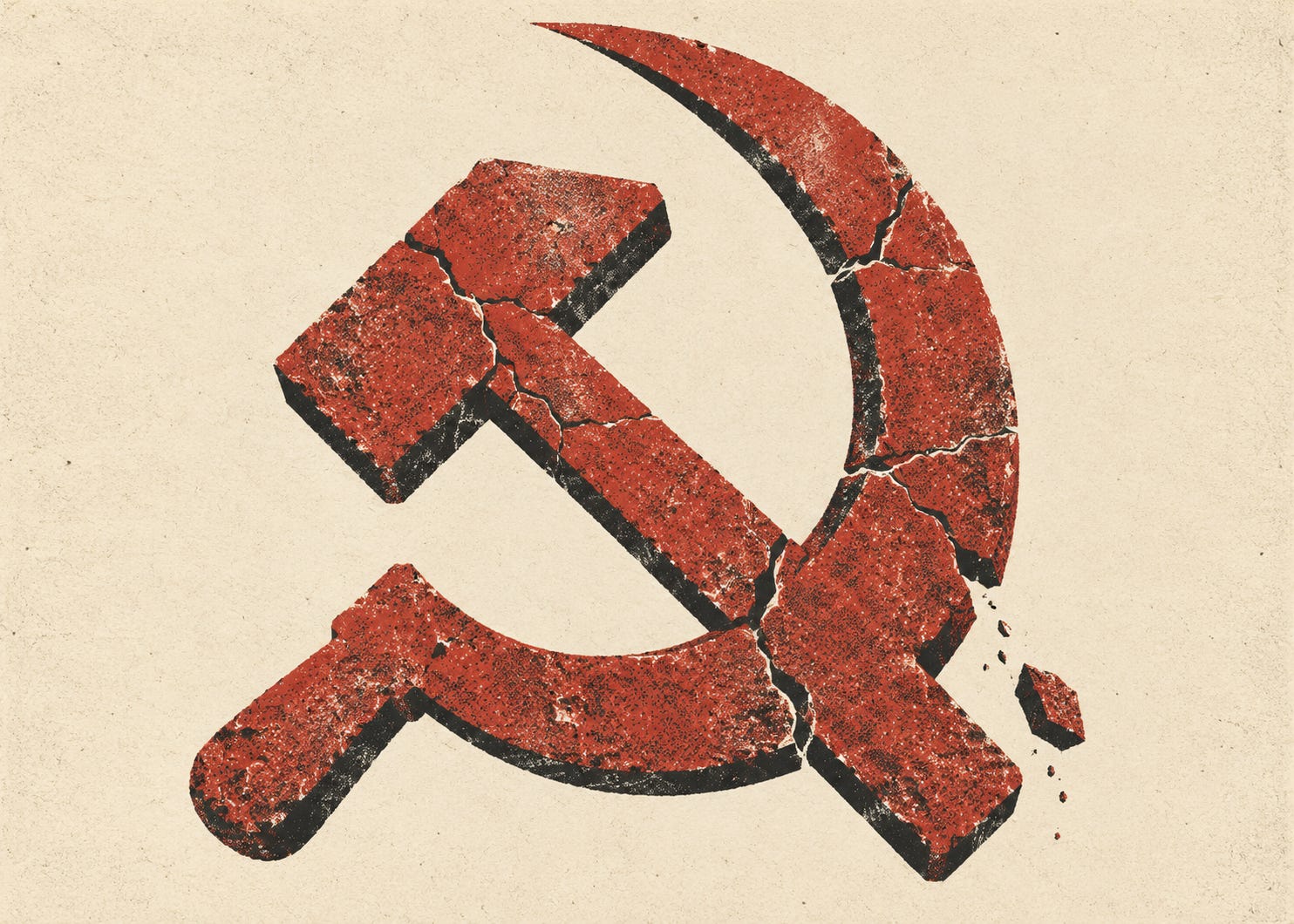
A Stateless, Classless, Moneyless Society
For a long time now, across many episodes of my 1Dime Radio podcast and at various points in my other work, I have engaged seriously with communist-adjacent ideas in an open-minded manner despite, at numerous points, explicitly stating that I am not a communist or a doctrinaire Marxist. I am definitely not anti-socialist, however, and I remain open to certain forms of socialism, depending on what we mean by that term. Perhaps one reason newcomers so often take me for a communist, both the right-wingers who assume I am one merely because I entertain these ideas at all, as well as the communists who come away disappointed that I will not serve as an ideologue for their side, is that I have made so many videos on the subject: my viral documentary on the Chinese Cultural Revolution, along with various videos on the theory and history of Marxism, in which I try to present these ideas fairly and objectively, far more charitably than the crude anti-communist propaganda the mainstream tends to feed us. I have also been explicitly influenced by Marxist thought in certain respects, from the lens of historical materialism to its emphasis on class conflict. So then, why am I not a Marxist? Quite simply, because I am not a communist. At least that’s one of the main reasons why I am not a worldview Marxist, despite adopting aspects of Marxian theory in my arsenal of theoretical lenses that I find useful. In this essay, I want to clarify exactly why I have never been one, despite years of open-minded and free dialogue with communists of all kinds.
While “socialism” has become more fashionable in recent years, the word “communism” remains frightening. This is partly due to decades of anti-communist Cold War hysteria. It owes at least as much to the disastrous legacy of regimes that built bureaucratic dictatorships in its name. “Communism” has become a synonym for tyranny itself. When most people denounce communism today, they are shadowboxing with Stalin’s ghost, not engaging with Marx’s vision. They imagine gray bureaucracies and bread lines, not the stateless, classless paradise that communists actually promise.
In this vulgar, Cold War sense (if by communism we mean Soviet communism, the popular sense of totalitarian state control), I am vehemently anti-communist. I have been accused of being a left anti-communist by Marxist-Leninists (the “tankies”) all the time as if it is an insult I should be offended by, as if it is not more shameful to still be a Bolshevik in 2026. But today, this kind of washed-up Soviet communism is no longer a real threat, even though support for it appears to be resurging in online communities. More importantly, the failure of actually existing Soviet communist-led regimes is not the only reason I am not a communist. There are, of course, communists who disown the Soviet Union entirely, insisting it had nothing to do with Marxism and was never advancing toward communism at all, while others defend the parties that ruled these countries as imperfect socialist experiments still aiming at communism in the long run. From Marxists of every stripe to anarchists and libertarian communists, the tradition is more divided than its critics assume, and I have traced its whole history in a two-and-a-half-hour documentary, “Types of Socialists Explained,” on the 1Dime channel. My disagreement, though, runs deeper than which regimes count. I am also critical of the very concept of communism itself: the end goal of a stateless, classless, moneyless society.
The shorter answer to why I am not a communist is simply this: communism, at bottom, is the belief in a stateless and classless society, and I do not believe such a society is possible, or even desirable, whether in theory or in practice, much as I see its appeal. This may surprise those who know how strongly I support certain socialistic policies, and are aware that I believe some kind of post-capitalist civilization is neccesary in the long run, not just for human evolution, but for the survival of humanity itself.
I have always been sympathetic to the ideal of communism, and I understand the appeal of communist intentions. The vision of human solidarity and material equality resonates with our deepest moral intuitions. Communalistic themes permeate religious texts from the Bible to Buddhist sutras. Yet sympathy for these aspirations must not blind us to their practical impossibility.
The Marxist conception of class, defined by one’s relationship to the means of production, might theoretically be abolished, though I remain skeptical. I should be clear here: Marx himself and most classical Marxists did not preach some childish fantasy of absolute sameness. They were not arguing that everyone should have the same talents, tastes, incomes, or social standing in every respect. The slogan was not total equality but from each according to ability, to each according to need. The real promise was a classless society, meaning a society in which no private class owned the means of production and lived off the labor of another.
But this is exactly where the problem begins. Anarchists are right to point out that you cannot have a genuinely classless society if a state remains above society, because the state itself becomes the new hierarchy. Yet if a stateless society is impossible beyond the intimate and local, then a classless society is also impossible in the literal communist sense. This does not mean we must accept grotesque inequality. Low relative inequality is possible, and as I have shown and articulated in my past essays (such as The Christian Case Against Capitalism, in Cadell Last’s Rosy Cross Anthology ), I lean instead towards a philosophy I call “limitarianism.” But moderation of hierarchy is not the same thing as the abolition of hierarchy. The communist promise quietly depends on abolishing the very political structure that makes large-scale society possible.
The Impossibility of Statelessness
Stateless societies have existed, but only at local scales. Tribal communities, certain anarchist experiments, kibbutzim, and other communal arrangements demonstrate that communistic life can function where people know one another, trust one another, and share thick bonds of obligation. This is the element that anarchist and communist sympathizers often mistake for proof that communism is simply human nature. They are not entirely wrong. Human beings are communitarian creatures. We are capable of solidarity, sacrifice, mutual aid, and common life. But we are also adaptive, competitive, hierarchical, suspicious, and tribal. Communism works locally not because human beings are naturally communist in some universal sense, but because local communities can generate the social trust that makes communist relations possible.
This is the missing precondition. Ibn Khaldun called it asabiyyah, group feeling, the social glue that binds people together strongly enough to act as a collective.[1] Durkheim later described something similar in terms of social solidarity.[2] This glue is usually built through kinship, religion, ethnicity, shared struggle, long habitation, or national feeling. It is not created by announcing a new set of ethical preferences at a general assembly. You cannot simply gather strangers, abolish property, and expect a durable commune to emerge by moral willpower alone. Where trust is high, the so-called tragedy of the commons may not apply in the crude way liberals imagine. Where trust is low, it absolutely does. Both sides of that debate can be right, because the decisive variable is not an abstract theory of human nature. It is the concrete density of social trust.
The most serious anarchist or quasi-communist experiments have usually been regional, ethnic, religious, or culturally bounded. Catalonia during the Spanish Civil War was not an abstract humanity-sized commune. It was rooted in Catalan culture, Catalan struggle, and a specific regional cause. Similar points can be made, in different ways, about the Basque country, Ukraine, Rojava, or other local experiments. This does not mean the answer is ethnic socialism, race communism, or some reactionary fantasy of blood and soil. It means the opposite of what modern ideological romantics want to hear: you cannot abolish the state without some other binding force strong enough to prevent predation, fragmentation, and conquest.
Once these arrangements scale beyond the local, the problem returns. Different groups encounter one another. Trust thins. Outsiders are treated differently from insiders. The communal relations that might exist within the group do not automatically extend to those beyond it. A stateless community can be democratic internally and warlike externally. It can share among its own people while conquering others, taking their land, or subordinating them. This is one of the hard lessons of Ibn Khaldun’s account of the rise and decline of civilizations: strong group feeling can build a people, but it can also become the force by which one people dominates another.
The state arises partly to contain this problem. It prevents clans, tribes, sects, classes, and ethnic groups from simply settling disputes through private violence. It also creates a wider political loyalty beyond the smaller group. Religion once did some of this work, especially monotheistic religions that unified different tribes and peoples under a higher sacred order. Nations later did it in a different form by turning strangers into fellow citizens. But even the nation-state depends on some shared loyalty. A low-trust society struggles to sustain democratic institutions, while a society where trust is trapped inside clans may require bureaucracy and coercion to hold the wider order together. This is the dialectic of social trust: too little solidarity and society fragments; too much loyalty to the smaller group and the state itself cannot become democratic.
The state, for all its violence, serves an essential function: it monopolizes legitimate force to prevent the chaotic violence that would otherwise erupt between competing groups. This monopoly (what Max Weber identified as the defining characteristic of the state) is indeed organized violence.[3] But it is a necessary evil that prevents the far greater evil of perpetual conflict. In a supposedly classless society, what stops armed groups from seizing property, controlling the surplus, and re-creating hierarchy? At the local level, trust and communal feeling can sometimes restrain this. At civilizational scale, only political institutions can. The democratic insight is not that this monopoly should be abolished but that those who wield it must not monopolize political power itself.
The Local and Total Society
Marxists claim to share the anarchist goal of statelessness but propose a different path: first establish socialism, abolish classes, then watch the state “wither away.” This formulation, inherited from Engels, rests on the premise that states exist solely as instruments of class domination.[4] Remove classes, the theory goes, and the state becomes unnecessary.
This reasoning collapses under scrutiny. Even in a hypothetically classless society, the need for coordinated defense, resource allocation, and conflict resolution would persist. When pressed on how statelessness could actually function at civilizational scale, thoughtful Marxists often reveal a telling assumption: it would require global revolution, a world system where communism has triumphed everywhere eventually.
For a stateless world to exist, there can be no outside, no other, no alternative. A single non-communist society would necessitate defensive state structures elsewhere, restarting the entire cycle of state formation. The logical endpoint[5] of communist theory is thus not the liberation of humanity but a one-world system that, despite its democratic pretensions, would likely be dominated by whatever powers spearheaded the revolution. This connects to a separate and more complicated argument, one I develop at length in a dedicated essay in Post-Left Theory: Beyond Marxism, Anarchism, and Vibes, my forthcoming book with David McKerracher, due out in late October and first discussed on my 1Dime Radio episode “What is Post-Left?” Some of the relevant logic can already be found in my Substack essay “Nationalist Internationalism.”
The Comintern’s transformation into a vehicle for Soviet imperialism was not simply an accident. Any movement that rejects national sovereignty in favor of international solidarity becomes vulnerable to capture by the strongest participating power. Communist parties worldwide, proclaiming internationalist ideals, became seen (often correctly) as agents of foreign influence.
These strategic vulnerabilities rest on a deeper contradiction in the theory itself, one Hans Kelsen identified in The Political Theory of Bolshevism.[6] Because Marxists treat the state as nothing more than an instrument of class rule, they can imagine only its eventual disappearance, never its limitation. Liberalism and republicanism developed theories of how to divide, bind, and check state power. Marxism offers only the promise that, once class conflict has been abolished everywhere, the state will dissolve on its own. Until that day arrives, nothing in the theory restrains the power exercised in the name of the working class. This is why Kelsen described Marxist communism as anarchism in theory and totalitarianism in practice: it promises the withering of the state while, in reality, providing communists with endless excuse to give the party-state absolute power.
Anarchism Cannot Scale
My critique of communism extends differently to its anarchist and Marxist variants. Actually existing anarchism often functions admirably when it remains small-scale, voluntary, and locally rooted. These communities mind their own business, harm few, and provide valuable experiments in alternative living. I respect them precisely because they often understand, in practice if not always in theory, that common life requires trust, proximity, shared norms, and mutual accountability. They work because they are not trying to administer humanity from nowhere.
Marxist regimes, by contrast, have inflicted massive historical damage. The excuse that these were not “true” Marxism rings hollow when we consider what success would actually entail: either a dystopian world government or the eternal deferral of the promised stateless society. The anarchists at least attempt to prefigure their vision in the present; Marxists postpone it to an ever-receding future.
Yet anarchism as a political philosophy, divorced from actual community-building, often devolves into nihilistic destruction. The impulse to tear down existing structures without clear alternatives is not liberation but entropy, a force of dissolution that clears ground for new forms of domination.
Communism Cannot Coexist With Markets
The impossibility of statelessness is not the only reason the classless society cannot be built. There is a second, bound up with the first, and it can be stated plainly: I believe in markets. My quarrel with capitalism has never been that it permits people to buy and sell. It is that capitalism subordinates the whole of social life to capital, allowing the imperatives of accumulation to decide what a society produces, how it measures its own success, and which human needs are permitted to count as real. Markets, however, are far older than capitalism and will outlast it. As Ellen Meiksins Wood argued in her book The Origin of Capitalism (1999), capitalism was not the natural fruit of the market’s expansion but a historically specific system of market dependence; exchange itself long predates the rule of capital and owes nothing to it. One may reject capitalism, then, without indulging the fantasy that human beings can be persuaded to stop trading with one another.
This is why the position of certain anarchists has always struck me as incoherent: those who would keep the market while abolishing both the state and private property. The three cannot be held together at once. Exchange cannot be quarantined from the wage relation. Once people are free to trade, some will always find it more sensible to sell their labor than to carry the risks and responsibilities of ownership themselves, whether for want of capital, of time, or of any wish to bind their lives to the fate of an enterprise. The wage is not a foreign body injected into the market from outside; it grows out of the freedom of exchange itself. A genuine market economy will therefore regenerate, again and again, the very private property and hired labor that communism set out to abolish.
This remains true even of the most egalitarian market economy one could imagine, a market socialism in which every enterprise is a worker cooperative or a collectively owned firm. A market is still a market: the more successful cooperatives outgrow the rest, and some, like Mondragon, swell into something barely distinguishable from an ordinary corporation, which is why keeping them from monopoly would still require a democratic state. The nearest thing anarchism has to a market vision, Pierre-Joseph Proudhon’s mutualism, makes the same concession in its own way, since it amounts to a form of libertarian socialism rather than a stateless and classless communism, which is why Marxists have long dismissed it as petit-bourgeois. I do not dismiss it, since I am not a communist. But the point holds regardless: whoever believes in market socialism has already ceased to be one, if they are being honest.
And private property, once free exchange has produced it, is more than a fact; it is a right, and a right is only as real as the institution prepared to uphold it. Such holdings must be secured by property rights, and property rights can be secured only by a state. Something must define what ownership is, adjudicate the disputes that exchange inevitably breeds, and enforce the line between what belongs to one person and what belongs to another. Remove that guarantor and property does not become common; it becomes whatever the strong are able to seize and keep. The market the anarchist hopes to preserve therefore rests on the very institution the anarchist hopes to abolish, since without a state to secure property rights there can be no secure property, and without secure property there can be no market at all.
The true communists (the Marxists who take overcoming private property, wage labor, and the value form seriously) grasp all of this, and that’s why they insist that communism is impossible without a fully democratically planned economy & common ownership. They see that a market does not merely generate inequality of income; it regenerates class. Exchange produces a surplus, and that surplus accumulates unevenly, so that advantage compounds into advantage until productive property gathers in a few hands and a division opens between those who own and those who do not. This division is not a distortion of the market but a product of it, and it returns wherever exchange is permitted to operate. From this the most consistent of them draw the honest conclusion: so long as production for exchange survives, so long as the value form itself is left intact, class will reconstitute itself no matter how the initial holdings are arranged. There can be no society of markets that is not also, in time, a society of classes. This is why they refuse to stop at taming or redistributing the market and demand instead that the value form be abolished outright, that production for exchange give way to conscious, collective planning. On their own premises, they are entirely right. If one truly means to keep class from reforming, one must abolish the market that keeps reforming it. Yet this is exactly where the argument turns back on them, for a planned economy is not a spontaneous order but an administered one, and the administration of an entire economy requires an administrator. No one has yet shown me how a whole economy might be planned without a state to do the planning. The road out of the market runs straight back to the state the communist set out to abolish.
Even if planning could somehow dispense with the state, I would still reject it, at least in its total form. An economy can perhaps be planned at its foundations, for the necessities and basic services whose demand is relatively fixed and whose provision is a matter of justice rather than taste. It cannot be planned for everything above that floor: for the immense and restless world of things people desire rather than strictly need, the goods that depend on craftsmanship and design, and on the unpredictable movement of human wanting that no board can foresee. These are what raise a life above mere subsistence, and no planning authority can conjure them the way a market can. There is also the old and stubbornly unanswered problem of incentives under planning, which I will not rehearse at length here, though János Kornai anatomized it thoroughly in his book The Socialist System (1992), and Vivek Chibber has recently set it out with great clarity in conversation with Joshua Citarella. The conclusion seems to me unavoidable. A market cannot breathe in a world that has neither a state to secure property nor a class of owners to do the trading, and so to will a stateless and classless society is to will the abolition of the market, while to will the abolition of the market is to summon a power vast enough to take its place. Communism does not merely strain to make room for markets. It cannot hold them at all.
The Abolition of Private Property
Beyond the impossibility of statelessness lies another fundamental reason I reject communism: the abolition of private property. While I acknowledge property as a root cause of inequality (a truth Jean-Jacques Rousseau articulated long before Marx)[7], the alternatives communists propose have proven worse than the problem they claim to solve. The communist solution assumes property can be collectively arranged at scale. Yet every historical attempt to implement common ownership beyond intimate communities has produced the same result: concentration of all property in the state. Those who imagine common ownership without state control must answer a simple question: what prevents predation? What stops the strong from simply taking from the weak? At a local and small scale, what prevents this is a strong society built on social trust. At civilizational scale, the only thing that can prevent it is a liberal democratic state.
The few successful examples of sustained common ownership (Israeli kibbutzim, various Indigenous societies) share telling characteristics: they are small, culturally cohesive, high-trust communities where social norms can effectively regulate behavior. Scale destroys these conditions. As societies grow larger and more diverse, informal mechanisms of social control break down, and formal institutions, ultimately the state, must step in to protect people’s property from each other.
The solution lies not in abolishing private property but in its radical redistribution, a republican ideal with deep historical roots. The American and French revolutions were revolutionary precisely because they expanded property ownership beyond a narrow aristocratic elite. What appears “bourgeois” today was radical then: before these revolutions, property concentrated in the hands of nobility, clergy, and monarchy. The revolutionaries widened the circle of ownership, and with it, the circle of freedom.
This should reframe a complaint we hear constantly today. When people say that capitalists own too much, they are missing the other half of it: most people own too little. The grievance is really about concentration, not property as such. Ownership has narrowed to a few hands, and the market is reproducing the concentration those revolutions once broke. Most people who resent this are not communists demanding the abolition of property; they have correctly identified the problem as too few owners, not too many. The answer to too few owners owning too much is more owners, not none, which means finishing the bourgeois revolution rather than reversing it.
Property, Independence, and Freedom
One of the core reasons I was never fully convinced by the Marxist conception of communism, even though I found it more compelling than the anarchist vision, is that I do not believe in the abolition of private property. Marxists will always try to emphasize the distinction between personal and private property, a distinction I am well aware of and have addressed in all of the videos I have made on Marxism. Even so, I do not accept the goal itself, for many reasons. Taken to its logical conclusion, it would mean that family-owned farms are unethical, that any small business with employees is unethical, and that the solution must be the common ownership of everything. I simply do not believe in that.
Furthermore, I think the Marxist and communist conception of private property misses what is actually radically democratic and liberating about it, and how central it was to the Enlightenment and to many of the freedoms we take for granted today. Jefferson’s vision, often misunderstood, was essentially a one-class society of small farmers, artisans, shopkeepers, and the petite bourgeoisie: a nation of property owners.[8] Not a society without property, but one where most citizens owned property. This republican tradition understood a truth that remains relevant: property creates independence. Without ownership of one’s means of subsistence (at minimum, one’s home), one remains in a form of servitude to others. The propertyless depend on property owners for survival, recreating the dependency of serf on lord. This insight that property is the prerequisite of liberty was widely believed by the most radical currents through Enlightenment political thought, uniting thinkers who otherwise diverged sharply, from Locke and Kant to Rousseau and Thomas Paine, who traced inequality to the accumulation of property yet insisted that only its wide distribution could make a citizen truly free.
Capitalism, ironically, betrays the ideals of the bourgeois revolutions it claims to embody. Marx’s great contribution in Das Kapital was documenting the proletarianization of the petite bourgeoisie:[9] the transformation of independent proprietors into a working class that owned nothing but their labor power and had, in the words of the Manifesto, “nothing to lose but their chains.”[10] Where early America saw widespread ownership, industrial capitalism produced sharp polarization between owners and non-owners, forcing many to sell their labor on a market. Jefferson feared exactly this: a growing class of propertyless citizens alongside a concentration of wealth among those with too much property.
For Marx, this process of proletarianization was not merely a tragedy but a precondition for revolution. The dispossession of the petite bourgeoisie would, he believed, create the material basis for communism by providing workers with both the incentive and the common political ground to overthrow the capitalist system. As class conflict intensified and the division between owners and non-owners sharpened, the transition to a society premised on the abolition of private property would become both possible and desirable. Marx and Engels envisioned the endpoint as a society of material abundance and common ownership under a democratic workers’ state, one that would eventually abolish class distinctions altogether.
Yet history did not unfold as Marx predicted. Marx was mistaken. The historical record demonstrates that attempts to abolish private property in regimes led by communist parties have consistently produced not liberation but new and often more totalizing forms of servitude. I have yet to encounter any coherent theoretical framework or practical example that makes the abolition of private property viable beyond the local scale. Until presented with compelling evidence to the contrary, I remain unconvinced that this core tenet of communist theory can function as anything other than a mechanism for concentrating power. History repeatedly shows that the rhetoric of common ownership and the abolition of private property serves to consolidate property within a bureaucratic state apparatus that claims to act in the name of the people, administered by a bureaucratic class that likewise claims popular representation while serving its own interests.
Distribution > Abolition
The alternative I propose is not the abolition of property but its radical democratization. We should strive for a society in which as many people as possible, ideally every adult of working age, can own a meaningful share of property. Such ownership provides the material foundation for genuine independence. The goal is to spread ownership as widely as possible, not to level everyone down into common dispossession.
Owning your means of subsistence is a precondition for freedom. The more people who have this freedom, the more power and independence they have from the state. This is the principle of radical republicanism: a society based on free laborers who own at least a certain degree of property creates freedom, whereas concentrated ownership of property destroys it. When everyone owns something meaningful, independence broadens. When few own most, freedom narrows to a small elite.
Marxist-Leninist regimes, by concentrating all property in the state, deepened the servitude they promised to abolish. Citizens depended entirely on the state for survival. The socialist goal should therefore be distributive: ensuring nobody accumulates excessive property while guaranteeing everyone a meaningful stake. Those who work the land should own it; those who work in enterprises should share ownership. This principle, that property rights should flow from productive contribution, explains my support for worker self-management and for a distributionist system designed to make ownership possible for as many working adult citizens as possible, in which access to ownership widens with the use a person makes of their property and with genuine need, and is made easiest of all for those raising larger families. Contemporary capitalism does the reverse: its property arrangements quietly penalize family formation, pricing the young out of the very independence earlier generations took for granted. The post-capitalist society I envision would invert that incentive, treating the raising of a family not as a private burden to be discouraged but as one of the surest foundations of a free and propertied people.
Parasitic forms of property (landlordism that extracts rent from multiple properties one does not inhabit, financial speculation divorced from value creation) contradict both republican and genuinely bourgeois ideals of earned ownership. Progressive taxation, land value taxes, and strict limits on property accumulation are not violations of property rights but their proper regulation in service of broader freedom.
Abolishing private property does not eliminate power; it concentrates it. The clearest historical illustration is the pre-Reformation Catholic Church. Its hostility to merchant power and usury often made sense in moral and theological terms, yet once the Church itself functioned as a property-holding class, that anti-commercial rhetoric coexisted with vast institutional wealth. Nothing in the Bible required the Church to become an economic class; that was a historical accretion, not a demand of the faith. An institution can speak in the name of equality, humility, and the poor while accumulating power over property in practice. Communist parties reproduced the same structure in secular form: denouncing private accumulation while centralizing property in the party-state. In both cases, the language of moral egalitarianism becomes the mask of institutional accumulation.
Property and democracy are dialectically linked. When people own nothing, government controls everything; when many own, they can check state power. The current crisis of democracy stems partly from property’s reconcentration: the top 1% wield outsized influence through concentrated ownership. Universal Basic Income, while potentially helpful, remains welfare, a dole rather than a share of ownership. True economic democracy requires distributed ownership: homes, land, shares in productive enterprises.
The democratic principle here is not that people are naturally good but that unchecked power corrupts. Economic concentration enables political domination. The moral case for socialism rests on limiting these concentrations, rewarding contribution on merit, and giving everyone a genuine stake in how society is run.
None of this, however, can be carried out by just any state. The government would need immense power to pull this off; however, democracy and strong executive power are not inherently at odds. But we must resist the temptation of relying on benevolent despots who ask us to grant them absolute power in order for them to impliment the people’s demands. The distribution of economic power cannot exist alongside an autocratic concentration of political power, like a single-party dictatorship, or any autocracy that holds a monopoly on political power. Such a regime has every reason to keep power concentrated and none at all to disperse the property and independence that would loosen its own grip on society. No benevolent dictator will save us. A genuine distribution of ownership can be achieved only by a state that is itself democratic and republican in character, open enough that the public can genuinely challenge and constrain those who rule. What the ideal form of such a state would look like in its particulars lies well beyond the scope of this essay.
Communism as a Phase in History
Part of why I was sympathetic to the classical Marxist view is that it viewed high-phase communism (a stateless, classless society) as a future stage of history we would eventually reach once human civilization has progressed enough. Once abundance is high enough that we have post-scarcity and labor becomes life’s prime want rather than a necessity. High-phase communism might be something worth taking seriously as a thought experiment that may only be viable after humanity has progressed deep into a post-capitlaist/socialist society. However, aside from the difficult questions about abolishing the division of labor & the technicalities of communism as an end goal, Marxism rests on deeply flawed assumptions about historical progress that can lead Marxists to misjudge the present and, ironically, rationalize capitalism. One of the more nuanced arguments made by Marxists is that proletarianization and the socialization of production are inevitable, and that the solution is to build upon the progress capitalism has made in order to more easily achieve socialism. It is a vulgar interpretation of historical materialism that often tempts communists into treating many of the ugliest features of late capitalism as potentially progressive developments that could lead to communism. I dissect this accelerationist tendency in Marxism in “Marxism as Accelerationism,” my essay in the Post-Left Theory book, and in my earlier essay “The Communism-Capitalism Convergence.” The monopoly corporation, the platform giant, the decline of the small business, the conversion of more and more people into renters, gig workers, debtors, and employees with no property of their own, all of this gets re-described as the historical precondition for socialism. The worse capitalism becomes, the more it supposedly prepares the ground for its transcendence. Amazon, BlackRock, the global supply chain, and the platform monopolies begin to look, in this imagination, less like the enemies of freedom and more like the accidental scaffolding of a future collective order. Once production is centralized enough, we are told, it will be easier to expropriate.
This is where Marxism turns into a dystopian wager. It mistakes the disease for the cure. Capitalism’s centralization of power does not train people for freedom but for dependence. It destroys the small proprietor, the independent craftsman, the family business, the local farm, the small shop, the owner-operator, and all the ordinary forms of ownership that once gave people some leverage against both capital and the state. It produces a world where more and more people own nothing, rent everything, and are governed by institutions too large to confront.
The communist looks at this and sees historical preparation. I see dispossession. The proletarianization of society is not a necessary stage on the road to emancipation. It is the catastrophe that needs to be reversed. A socialism that needs capitalism to first destroy the independent bases of social power is not an alternative to capitalism. The abolition of property can so easily converge with corporate feudalism, or what might be called corporate communism. In both cases, ordinary people are told that ownership is no longer for them. They can have access, subscriptions, welfare, services, bureaucratic rights, and maybe even a nicer app. What they cannot have is independence.
The older bourgeois and republican dream was different. The promise of the Enlightenment and the bourgeois social revolutions was not that everyone would become propertyless under some enlightened collective authority. It was that arbitrary power would be broken by giving ordinary people a sphere of independence. Property was supposed to be more than a legal right: it was meant to be the material basis of liberty. That is what capitalism betrayed. Instead of producing a stable society of free proprietors, capitalism produced a world where wealth is increasingly accumulated through ownership rather than labor, while those without property must sell themselves piecemeal just to survive.
This is the problem Marx diagnosed correctly, even if his solution was wrong. Bourgeois society proclaimed liberty, equality, and independence, yet industrial capitalism created a class with no meaningful property and therefore no real independence. Marx was right to see the contradiction. He was right that the promise of liberalism had been denied to the working class. But the answer is not to abolish what made liberty material. It is to extend it. The promise of liberalism should be fulfilled, not negated. The right to property should stop being the privilege of an owning class and become one of the foundations of a post-capitalist order.
This is also what separates my critique from a purely right-wing anti-communism. I am not defending capitalism as such. Capitalism is a mode of production in which capital rules society. Markets existed before capitalism, and property can exist beyond capitalism. A post-capitalist society does not have to mean a society without markets, without capital goods, or without personal property. It can mean a civilization in which capital is subordinated to the needs of society as a whole, the common good. This must be actualized not through reliance on the paternal will of benevolent autocrats, but through widespread distribution of power & ownership, so no class can accumulate enough property to become a new aristocracy and/or oligarchy.
So the solution is distribution, not abolition. The aim is to extend economic freedom to more people, not to place faith in collective dispossession as a path to liberation. We should not cheer for monopoly capitalism because it allegedly simplifies the transition to socialism. We should break up, socialize, democratize, and distribute power in ways that let people own homes, hold stakes in the enterprises they build, inherit some real security, and live without being permanently dependent on landlords, corporations, creditors, or the state. In a world where neo-feudal capitalist oligarchs increasingly tell us to own nothing and be happy, the socialist answer should not be to complete that dispossession in red language. It should be to say that ownership, independence, and property are too important to be left to capitalists.
Limitarianism and the Distributed Republic
What I am defending, then, might be a kind of radical social democracy that may or may not be considered a form of socialism, but one based on “limitarian” principles rather than libertarian utopianism or totalitarian statism. Just as we already accept limits on political power through constitutions and the separation of powers, limitarianism holds that we must accept limits on economic power, so that no one can accumulate enough wealth to convert it into domination over others. It could also be called republican socialism, democratic republicanism, or post-capitalist property democracy. I care less about the label than the substance. I reject capitalism because it subordinates society to capital. I reject communism because it tries to cure that domination by abolishing the very material basis of personal independence. Capitalism concentrates property in private oligarchies. Communism, when implemented at scale, concentrates property in the state. The result is different in theory, but frighteningly similar in practice: ordinary people are made dependent on powers they cannot realistically control.
The alternative has to be built around a different principle. Subordinate capital to society, but do not absorb society into the state. Democratize property, but do not abolish the conditions of personal autonomy. Preserve markets where they serve human needs, limit them where they become socially destructive, and prevent ownership from hardening into a hereditary ruling class. Equality through universal powerlessness is not emancipation. Freedom requires distributed power.
This is why the property question and the state question belong together. The local commune can share property because its members know one another, trust one another, and can hold one another accountable. A civilization cannot be organized on the assumption that strangers will automatically behave like kin. If communists want to abolish the state, they need another force strong enough to hold social life together. Historically, those forces have been kinship, religion, ethnicity, region, nation, or shared struggle. Yet modern communists are often hostile to the very sources of social glue that make communal life possible. They want the intimacy of the tribe, the moral unity of religion, and the solidarity of the nation, while dissolving the conditions that produced them.
Nor should socialists romanticize capitalism’s own centralizing tendencies. The monopoly corporation, the platform economy, the financial landlord, and the global investment fund are not accidental previews of socialism. They are the enemies of a free society. To welcome their growth because they might make expropriation easier is to accept a politics of historical despair. It is to say that people must first be stripped of property, locality, and independence before they can be free. I reject that logic completely.
The future worth fighting for is not an impossible communist dream of a stateless, classless, moneyless world that can be easily used by totalitarian demagogues to use the state to concentrate power for themselves, nor the capitalist nightmare of permanent renting, debt, surveillance, and dependence. It is a democratic society of widely distributed ownership, strong local and national institutions, worker power, limits on accumulation, and a state democratic enough to restrain oligarchy without becoming the owner of everything. This is much closer to the radical promise of the American Revolution and the bourgeois social revolutions than to the Bolshevik seizure of state power. The point is not to absorb society into the state but to expand independence through property, citizenship, worker power, and democratic institutions.
A Third Way?
Defending this position can occasionally earn a strange accusation. Because I reject capitalism as the rule of capital and communism as the abolition of the state, and argue instead for a third way of widely distributed, democratic ownership, I am sometimes called a “fascist” by communists, who wield the word loosely. What they have in mind is the Third Position, the family of authoritarian doctrines that claim to stand beyond capitalism and socialism, beyond left and right, and that are as a rule neo-fascist or close to it. Their reasoning is that any road running between capitalism and communism must arrive there, an inference that forgets social democracy exists and that most positions are neither communism nor fascism. It forgets, too, that the ground between capitalism and communism has long been held by traditions with no appetite for dictatorship. The most notable is distributism, the Christian anti-capitalism of G. K. Chesterton and his circle, whose complaint against capitalism was that it produced not too many capitalists but too few, and whose answer was to spread property as widely as possible rather than abolish it or hand it over to the state. The irony is that what actually defined fascism, the single party, the cult of the leader, the silencing of dissent in the name of a higher unity, is precisely what these same communists will defend once it flies a red flag. The third way I want is the opposite of the Third Position in the one respect that decides the matter: it disperses power and answers to the many, where the other gathers power and answers to a vanguard or a strongman. A politics of democracy and distributed property is not fascism.
Others, more charitably, take what I am defending to be distributism pure and simple. Distributism is certainly not fascism, and it’s closer to my kind of political vision. I like a lot about that ideology and am inspired by it, however, I would not say that I endorse it unambiguously, because I do not think it is solidified or concrete enough as a doctrine. I agree with much of it, and I support large parts of it at the level of policy and values. But any ideology like it, formulated more than a century ago, needs to be modernized for the present day and its material conditions. Still, that vision is closer to mine than one concentrated solely on state ownership. I do, however, see a role for powerful state ownership, state investment, and state-led direct investment in the economy, which is why I like many things about Modern Monetary Theory (MMT), a subject I have covered a great deal in my past work.The state, as I see it, should be one owner among many, powerful where it must be, but never the only one. Any political vision, wheather Marxist-Leninsit communism, Fascism, or Nazism, that relies on the state as the answer to all problems in society amounts to totalitarianism.
Your Leftist Faves Aren’t Communists Either
Many people get pipelined into the idea of communism through popular “Marxist-adjacent” figures like Richard Wolff and Yanis Varoufakis. But the irony is that these two intellectuals aren’t actually communists either. Contemporary socialist thinkers like Richard Wolff and Yanis Varoufakis often avoid the communist label because they recognize that socialism can challenge capitalism without embracing communism’s impossible dream of total transformation. That distinction matters. A socialism worth defending should pressure capitalism toward democracy, property distribution, worker power, and social independence. It should not treat dispossession as a historical shortcut to liberation.
That is why I am not a communist. Not because I lack sympathy for equality, solidarity, or the longing for a society beyond capitalism. I am not a communist because I take the problem of power seriously. I do not believe in any long-term vision, capitalist or communist, in which people are ultimately meant to own nothing and be happy. Communists like to dodge this by insisting they oppose only private property, not personal property. But take the Marxist definition of private property seriously, one that narrowly reduces it to the exploitation of surplus value, and the small business owner, the farmer, the sole proprietor, and anyone who owns capital and hires labor all stand condemned, however much cost, work, time, and energy they themselves shoulder alongside their workers. I want a world where ordinary people have enough property, independence, and democratic power to stand upright against both capital and the state. If there is any socialism worth the name, it is a socialism built on the distribution of economic power, which I take to be the necessary complement to what I regard as the central function of democracy: the distribution of political power. In my view, democracy & autocracy and socialism & capitalism should be viewed not as fixed systems, but as axioms that can be actualized to varying extremes. Even ancient Athens, the purest “real democracy” in history, had very undemocratic elements (women having zero rights, and only a small polity of citizens could vote), and the Soviet Union concentrated economic power in the hands of the state, the planners instead of capitalists, while the majority of ordinary citizens were planned. If state ownership is what is supposed to define socialism, then the “Democratic” Republic of North Korea would be more socialist than modern China or Vietnam. Is such a narrow statist definition of socialism worth maintaining today? I say no. Instead, both democracy and socialism run along a spectrum, with communism at the far extreme, a limit I do not endorse, just as I do not believe that the full democratization of everything is practical or desirable either. I further develop this theory of how to define socialism and democracy in my essay “Socialism and Class in the 21st Century,” part of my book with David McKerracher titled Post-Left Theory: Beyond Marxism, Anarchism and Vibes, which I encourage my readers, listeners, and viewers to check out when it comes out on October 15th, 2026.

If you enjoyed this essay, you can read Part 2 of why I am not a communist here, in which I elaborate on why I don’t think a stateless, classless, moneyless society is the fairest & most just system even in theory, not just in pracrice.
Works Cited
[1] Ibn Khaldun, The Muqaddimah: An Introduction to History, trans. Franz Rosenthal, 3 vols. (Princeton, NJ: Princeton University Press, 1958).
[2] Émile Durkheim, The Division of Labor in Society, trans. W. D. Halls (1893; New York: Free Press, 1984).
[3] Max Weber, “Politics as a Vocation,” in From Max Weber: Essays in Sociology, ed. and trans. H. H. Gerth and C. Wright Mills (New York: Oxford University Press, 1946).
[4] Friedrich Engels, Anti-Dühring: Herr Eugen Dühring’s Revolution in Science (1878; Moscow: Progress Publishers, 1947), part 3, chap. 2.
[5] Cf. Francis Fukuyama, The End of History and the Last Man (New York: Free Press, 1992), the rival account of history’s endpoint.
[6] Hans Kelsen, The Political Theory of Bolshevism: A Critical Analysis (Berkeley: University of California Press, 1948).
[7] Jean-Jacques Rousseau, Discourse on the Origin and Foundations of Inequality Among Men (1755).
[8] Thomas Jefferson, Notes on the State of Virginia (1785), Query XIX.
[9] Karl Marx, Capital: A Critique of Political Economy, vol. 1 (1867), part 8, “So-Called Primitive Accumulation.”
[10] Karl Marx and Friedrich Engels, The Communist Manifesto (1848).
Your support helps keep my entire 1Dime project alive and independent! Support my work on Patreon to get access to over 100 exclusive episodes of the 1Dime Radio podcast and private Discord access.
Well said Tony. I share these core political values with you. I've written dozens of policy proposals to transition a neoliberal country to distributed ownership of enterprise, land and power. Have a look:
https://docs.google.com/document/d/1HyqVpDEeTKyswqUU3ZZD-5gSaRzcudve4VpSOzr0Wkc
The policies with highest impact among them I think are transitions to liquid democracy and to worker ownership of for-profits, introduction of a market share tax, a basic income calibrated against inflation signals and a paradigm shift away from balancing the government's budget toward balancing the business cycle with government spending.
Structured and gave me a lot to think about, thx.